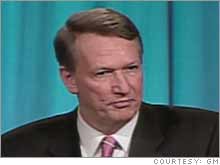
GM CEO: Alternatives to gas neededWagoner hypes green efforts at annual meeting but argues against tougher mileage rules; greenhouse gas proposal defeated.NEW YORK (CNNMoney.com) -- General Motors Chairman Rick Wagoner told company shareholders Tuesday that moving away from gasoline-powered cars is crucial for the company's long-term business prospects, although he argued tougher government regulations on mileage requirements are not the way to get there. And a preliminary vote of shareholders at the company's annual meeting Tuesday showed GM (Charts, Fortune 500) management defeated a shareholder proposal that would have pushed the board to publicly adopt greenhouse gas reduction goals for its products and operations. Still, although it was defeated, about 26 percent of shares voted in favor that proposal.
Speaking at the meeting, Wagoner said that while GM made great progress in turning around its business in the last year, more cost savings must be won in upcoming talks with the United Auto Workers union in order for the company to be competitive. And he said that the company's overseas sales should help its revenue growth, even as it has been losing market share in its home U.S. market. But much of the talk of his brief prepared remarks focused on environmental issues, rather than traditional sales and profit discussions that dominate nearly all annual meetings. "We'll continue to improve the efficiency of the internal combustion engine, as we have for decades," he said. "But importantly, we're also dramatically intensifying our efforts to displace traditional petroleum-based fuels." Wagoner criticized the so-called CAFE standards, the U.S. government's mileage requirements, which some proposals now before Congress would raise. "It's time to move beyond exclusive reliance on the historical regulatory approaches that clearly haven't solved these problems, like CAFE, and move forward to embrace solutions that will yield the results that we need - lower oil consumption, lower oil imports, lower carbon gas emissions," he said. Wagoner again pushed GM's offerings of vehicles that can run on either gasoline or a blend of 85 percent ethanol known as E85. "It's increasingly clear that, of anything that we can do over the next decade, ethanol has by far the greatest potential to actually reduce U.S. oil consumption, reduce oil imports, and reduce carbon gas emissions," he said. But E85 has only limited availability, and there have been many questions raised as whether production of ethanol consumes more energy than it saves. Wagoner announced two new contracts Tuesday for advanced development of lithium-ion batteries for electric and fuel cell cars and trucks that are still in development. The value of the contracts, with U.S. units of Korean and German owned companies, was not disclosed. GM has badly lagged Japanese competitors such as Toyota (Charts) and Honda (Charts), as well as U.S. competitor Ford Motor (Charts, Fortune 500) in rolling out fuel-efficient gas and electric hybrid vehicles. With record high gasoline prices leading consumers to return to cars rather than the SUVs and pickups that GM depends upon, GM has scrambled to improve its fuel economy performance and image. GM is trying to leap over those rivals' advances by announcing plans for a more efficient "plug-in" hybrid that can recharge the batteries and essentially run an electric-only vehicle. But battery technology is not advanced enough to make those vehicles commercially viable. GM was the first automaker to join the U.S. Climate Action Partnership, a group of U.S. corporations pushing for reductions in greenhouse gases. The group of nuns from Montclair, N.J., who filed the shareholder resolution on greenhouse gases, argued the company needs to do more. "Our company is currently suffering financially in part because our competitors are making more compelling products that are both fuel efficient and low-pollution passenger cars resulting in a recent alarming loss of market share in this era of higher oil prices," said the shareholder proposal. "In order to protect and enhance long-term shareholder value GM must retake market share from its competitors." But GM's management argued that adoption of additional goals on greenhouse gas emissions and the preparation of an additional report, as requested by the proposal, would not be a good use of corporate resources. |
Sponsors
|