Dark horse in the Dow Jones fightSupermarket mogul Ron Burkle could make an offer this week with a surprising partner and less-than-high minded support from the union, says Fortune's Tim Arango. NEW YORK (Fortune) -- Rupert Murdoch's dealmaking has a tendency to upend the media apple cart, setting off a chain reaction of behind-the-scenes chess moves. In some cases, titans even lose their jobs - as Viacom Chief Executive Officer Tom Freston did after Murdoch cinched a deal to buy MySpace. As Murdoch waits for the Bancrofts, the mercurial family that controls Dow Jones (Charts), to decide on a proposal to ensure editorial independence at The Wall Street Journal under News Corp. (Charts, Fortune 500) management, various parties, such as General Electric, Pearson, Hearst and Barry Diller, have been scrambling to weigh a bid. Yet would-be white knights have thus far failed to come up with an offer - mainly because of Murdoch's $60 per-share price, which is prohibitively rich by design.
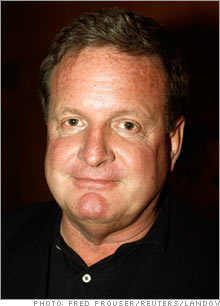
That could all change this week: While the morning's papers brought news that General Electric (Charts, Fortune 500) and Pearson are days away from deciding whether to partner on a bid, the billionaire supermarket mogul Ron Burkle is still working with Dow Jones' union and could go public this week with a longshot offer for Dow Jones, according to a source in the Burkle camp. This person said Burkle, who was first mentioned two weeks ago as a potential suitor for Dow Jones, has been trying to enlist the beleaguered Internet giant Yahoo! (Charts, Fortune 500) as a partner for a bid. Burkle, the Los Angeles-based mogul, sits on Yahoo!'s board of directors, and as a member of that company's compensation committee recently came under scrutiny from shareholder activist types for approving a package that paid over $70 million to Yahoo! CEO Terry Semel last year. Given the Internet company's struggles competing on search with Google, an entry in to the slow-growth newspaper industry appears unlikely. That hasn't stopped Burkle from trying to make the case to Yahoo!, according to a source, who said that Burkle is also considering various other partnerships in conjunction with Dow Jones' union. All of this begs the question: Why would the union prefer Burkle to own the Journal over Rupert Murdoch? The union has couched its support for Burkle in terms of editorial integrity - basically taking the ABR side: Anyone But Rupert. But there is little in Burkle's background to suggest he would be a champion of the free press values that the Journal stands for. Most famously, last year Burkle, who long blanched at his personal life being fodder for the tabloids, took matters in to his own hands when he filmed a meeting with a reporter for the New York Post's Page Six in which the reporter allegedly shook down Burkle for payments in exchange for favorable coverage. (No charges were filed.) A less discussed matter was Burkle's support for a California law - vehemently opposed by media organizations - that would have shielded from public view records in divorce cases. (Burkle went through a messy divorce, and wanted the details kept out of the papers.) For this reason - along with Burkle's staunch support for Democratic candidates and liberal causes - it's hard to imagine that he would be a palatable choice for the Bancrofts. The real reason for the Dow Jones' unions link to Burkle isn't about editorial integrity - even if the union's public statement says its aim is to "safeguard" the "independence and integrity of Dow Jones." The real reason is this: Burkle has a history of being a strong union supporter, while Murdoch is known for busting unions in London in the 1980s when he switched the printing plant for the Times to his own non-union shop in East London. A representative for Burkle's firm, Yucaipa Cos., did not return a call seeking comment. It's not the first time Burkle has sought to add a newspaper to his empire. Most recently he made a play to buy the Los Angeles Times from the Tribune Co. (Charts, Fortune 500), which eventually sold out to the real estate tycoon Sam Zell. Last year he also worked with the union representing employees at the newspaper chain McClatchy (Charts), which was seeking to unload several papers after purchasing Knight Ridder for about $4.5 billion. (He also worked with unions in a failed bid for Knight Ridder itself.) In that bidding, Burkle worked closely with Ownership Associates, a Boston-based firm that advises unions - the same firm he is aligned with in considering an offer for Dow Jones. |
|