By
David Whitford, Fortune editor-at-large
(Fortune) -- One thing I've learned on my 7,000 mile journey through America's nuclear past and present is that when you're driving around scouting for a power plant -- any kind of power plant -- first locate the high-voltage transmission lines. (If you stand directly under those lines, sometimes you can hear the electricity cackle and spatter like rain drops on the roof.)
Then check the lay of the land. Then follow the downward slope to the water. Could be a river you're looking for, could be a lake (natural or man-made). Could be the ocean. But here's the rule: No water, no steam; no steam, no power.
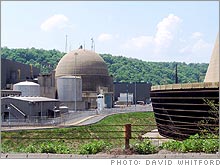 |
| Beaver Valley Nuclear Generating Station |
The industry is gearing up to build its first new plants in decades.
How bad was the accident really?
The industry is coming alive in the Midwest's Ohio Valley.
Will power companies foot the bill?
It's not easy building a home for spent radioactive material.
An Idaho lab is at work on next generation reactors that promise to deliver more reliable energy.
That's how I found myself late one Friday night (maybe it was Saturday morning), twisting and turning on steep, curvy roads, descending into Shippingport, Pennsylvania, an old ferry crossing on the Ohio River. All I could see in the darkness were the faint outlines of cooling towers, festooned with blinking red lights.
Came back the next day to have a look around. A surveyor's stake, set just across the river in Ohio on August 20, 1785, marked the "point of beginning" for plotting the public lands of the United States. That's noteworthy, since Shippingport also marks a different kind beginning point. It's the site of this country's first large-scale commercial nuclear reactor.
Designed by Westinghouse, built in partnership with the Navy, and operated by Duquesne Light Company, the Shippingport reactor began generating electricity in December 1957 and was decommissioned in 1982. (The towers I saw belong to two new nuclear reactors in Shippingport, Beaver Valley 1 and 2, and a coal plant, all operated by FirstEnergy.)
All that remains of the original plant's history, a security guard tells me when I stop to ask, is the shell of the old control room and a photograph of President Eisenhower -- architect of the "Atoms for Peace" policy -- on the wall at the new training center.
Fifty years after Shippingport, signs of the US nuclear revival are popping up all over this part of the country. In Piketon, Ohio, for example, east of Cincinnati, the former government entity USEC, which is now private, is demonstrating the latest in US owned-and-operated technology for enriching uranium.
USEC hopes to begin supplying enriched Uranium to nuclear fuel fabricators as early as 2009. "What we're trying to do as quickly as we can is position ourselves for the growth of nuclear power," says a company spokesperson.
A market surge
BWXT, formerly Babcock & Wilcox, also hopes to supply the burgeoning industry. The company's cavernous facility in Mount Vernon, Indiana, across the Ohio river from Kentucky, is the only factory in America that can still make large-scale components for nuclear power plants.
Last year BWXT signed an agreement to team up with with French nuclear giant Areva to build reactor vessels for US utilities. Ed Woolsey, the recently retired VP of BWXT's nuclear division who showed me around, told me he expects to be operating at capacity by 2015.
"There is we believe a real strong market that's emerging, and we're preparing ourselves to be in play for that market," he says. "Our biggest challenge is to screen, hire the people, train the people and have them ready to go once the work gets here."
Email: dwhitford@fortunemail.com