
How Bear Stearns lost its wayEntrepreneurial but plodding: That was Bear Stearns. Then it strayed into high-risk hedge funds. Fortune reports. (Fortune Magazine) -- By all rights, this should be a Bear Stearns moment. Investors are skittish, and Wall Street players are unsure what to do next -- precisely the conditions under which the scrappy independent has traditionally thrived. Its bare-knuckle approach to the mundane business of trading, especially complicated debt securities, made it the classic countercyclical play -- successful in up markets, stellar in downturns. Bear is a link to Wall Street's past, when brokerages survived more on their moxie than on their spreadsheets. 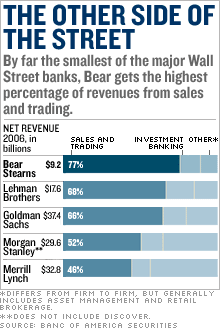 Instead of reveling in the moment, though, Bear Stearns (down $1.90 to $116.30, Charts, Fortune 500) has stumbled; now CEO James Cayne must lead it through one of the biggest crises of confidence in its 84-year history. Two hedge funds run by its asset-management division have gone belly-up. On Aug. 5, Cayne dumped his heir apparent, the much-admired Warren Spector; Cayne and his new No. 2, investment banker Alan Schwartz, are defending Bear's reputation -- and trying to persuade the Street that the firm can weather the credit storm -- even as they quietly seek an equity investment. Bear got into this jam in part by coveting its neighbor's business. At Bear, trading and handling money for clients has always been the main game. The firm made a steady profit as Wall Street's back office. The businesses "weren't very sexy," says Michael Holland, chairman of the eponymous money management firm, "but they looked really good when things went lousy for a lot of their competitors." For a long time that was enough. Particularly under the leadership of the legendary Alan "Ace" Greenberg, Bear's disciplined trading culture made it the "Sparta of Wall Street," in the words of Bernstein analyst Brad Hintz. It's hard to escape the impression that Bear grew jealous of the sexy -- and hugely profitable -- hedge funds run by the likes of Goldman Sachs (down $2.24 to $172.76, Charts, Fortune 500). When Bear decided to get into this riskier action, it did so in a typically Bear-ish way: by channeling other people's money into the funds, and only a little of its own. Bear saw the hedge funds as entities separate from the rest of the company. Perhaps that's why it departed from character in the way it ran them. Instead of being highly risk-conscious and attentive to detail, the funds missed warning signs in the subprime mortgage market, and top management seemed disengaged. Cayne, an avid golf and bridge player whose hobbies did not appear to suffer during the turmoil, also cut out of a tense early-August call with analysts shortly after it began. The hedge funds' troubles started in April, worsened in May, and by mid-June had become a full-blown crisis. Even Bear's injection of $1.6 billion couldn't save them. By mid-July both were next to worthless. Less than three weeks later, the stock was way down, Spector was gone, and Bear was selling more than $2 billion in debt -- both to shore up its balance sheet and to demonstrate that its assets were still valued. A former Bear executive sums up the irony: "The culture of being conservative and not betting the house's money -- all that got undermined." Bear has long prided itself on being different from the rest of the financial community, which in turn has kept a wary eye on Bear. "I've never seen a company that operates the way they do," says a major player at a competitor. "It's always them first." Bear's refusal in 1998 to assist in the bailout of Long-Term Capital Management still rankles Wall Street. There is, then, more than a little schadenfreude that the lone wolf is howling at the fates. Bear likes to brag that it has been profitable every year; for all its troubles, it will probably make money this one too. "We've never been a giant organization, so we have always had to rely on being nimble and creative," says Schwartz. "We think that gives us an advantage in this type of environment." In other words, Bear is ready to trade in its uncharacteristic missteps and return to its strength -- a tenacious culture that thrives in tough markets. Corey Hajim was a Bear Stearns research associate from 2004 to 2005. |
Sponsors
|


