
Getting women to the highest levelsWomen are gaining more spots in executive suites and on corporate boards, but parity with men still seems decades away. Fortune's Carol Loomis examines the executive gender gap. DANA POINT, Calif. (Fortune) -- The good news for women is that they have gained ground in the corporate hierarchy. According to Catalyst, a New York organization that works to expand corporate opportunities for women, in 1995 women held only 9.6% of the Fortune 500's board seats. Today, their share is significantly higher, 14.6%. But the really bad news is that at this rate of gain - about a half of a percentage point per year - it will take women 73 years to achieve what Catalyst's president, Ilene Lang, calls "parity" (boards divided 50-50 between men and women).
Interactive graphic
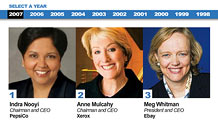 In honor of the 10th edition of Fortune's Most Powerful Women list, we're looking back at who made the top 3 each year.
See them all Such parity might seem reasonable considering that women make up a large 46.3% of the total work force. Historically, though, once the jobs in question are above middle manager, women become far scarcer. Catalyst's Lang, a participant in Fortune's Most Powerful Women Summit, says that women hold only 15.7% of the Fortune 500's corporate officer positions. That's up from 8.7% in 1995, but again, at that rate, "parity" is 43 years away. What accounts for the paucity of women at high corporate levels? Lang does not believe that motherhood is to blame. For an example of a woman doing it all, Lang points to Susan Wojcicki, who in 1999 became Google's (Charts, Fortune 500) first marketing professional and is now the company's vice-president for product management. Wojcicki has three children and is pregnant with a fourth. The true reasons that women are held back, Lang contends, are the "old-boy" network; stereotypical doubts that people have about the ability of women to lead; and the fact that women lack role models at the top. Says Lang, "If women don't see themselves there" - on boards and in the executive suite - "they don't see themselves there." The world doesn't have to work this way, says Lang. She describes the ascent of Indra Nooyi, who heads FORTUNE's list of the most powerful women, to her job as chairman and CEO of Pepsico (Charts, Fortune 500). The company recognized Nooyi's talents and nurtured them, says Lang admiringly: "Pepsico encouraged everything about her that makes her what she is." In stark contrast, many FORTUNE 500 companies do not have even a single woman in their corporate officer list. And on the board front, Catalyst counts more than 50 of the 500 that lack women directors entirely. Among those companies are Rupert Murdoch's News Corp (Charts, Fortune 500)., Apple Computer (Charts, Fortune 500), and Bear Stearns (Charts, Fortune 500). Lang particularly commends those companies that have two or three women directors. "If they have that many," she says, "you know they've worked at it." That many women on a board, or still more, allows these directors to stop representing their gender and be themselves. Each can be an individual, Lang says, and that's the kind of thinking and voice you want on a board. |
Sponsors
|




