
Bracing for more air travel headaches
Analysts say travelers should expect higher air fares and crowded planes after the latest airline, United Airlines, said it would cull aging 737s and 747s, and reduce its payroll by 1,400 to 1,600 jobs.



NEW YORK (CNNMoney.com) -- Get ready for higher airfares and get used to those crowded planes as rising oil prices force airlines to face the grim prospects of finding ways to deal with multi-billion dollar fuel bills.
In the latest move from the battered airline industry, United Airlines said Wednesday it will reduce its fleet by 100 planes by 2009 and will cut 1,400 to 1,600 jobs to stave off losses related to fuel costs.
This means that passengers will pay even more to fly as airlines scramble to curb their losses from escalating fuel prices, analysts said. To add insult to injury, the planes will also get more crowded as airlines reduce capacity.
Raymond Neidl, airline analyst for Calyon Securities, said the airlines would have to raise ticket prices by at least 30% to match fuel costs, though he said it's unlikely they could get away with an increase that steep.
Michael Derchin, airline analyst for FTN Midwest Securities, said passengers should expect fares to go up another 5% through 2009, on top of the 7% increase that's already happened this year.
"The marginal traveler will be priced out of the market, as it should be in this environment," said Neidl. "The consumer's not paying his [share] with these oil prices. They've got to start pricing the product to reflect the cost of producing the product."
Since airlines are trying to save money by reducing capacity, Derchin said that passengers should expect more crowded planes.
"With this level of capacity reduction, you're talking about load factors in the 90% range, which effectively means full airplanes wherever you go," said Derchin. "The choice for consumers will be reduced, meaning fewer flights and fewer destinations."
Derchin said United's capacity reductions would have the most impact on its hubs in Denver, Chicago, San Francisco and Los Angeles.
United, owned by UAL Corp., (UAUA, Fortune 500) said it was culling six B747s and its entire fleet of 94 B737s. The airline described the B737s as its "oldest and least fuel-efficient" planes. The company's stock rose more than 11% on the news.
The money-losing airline industry is fighting for survival under the weight of escalating oil prices. United said it is making the cuts to help deal with an additional $3 billion in fuel costs this year. On Monday, the International Air Transport Association, representing 240 carriers, projected that soaring fuel prices would cause the industry to lose $2.3 billion this year.
United is the latest to announce cuts to jobs and planes, but it won't be the last, said Neidl of Calyon.
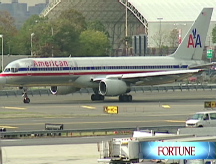
American Airlines said on May 21 that it would reduce capacity by 11% to 12% in the fourth quarter. The Associated Press quoted Chief Executive Gerard Arpey as saying he might lay off thousands of staffers. American, owned by AMR Corp., (AMR, Fortune 500) is the leading U.S.-based carrier.
Neidl said that Delta Air Lines (DAL, Fortune 500), the third-largest airline in terms of annual sales, will probably be the next among the major carriers to slash jobs and ground aircraft.
Bob McAdoo, airline analyst for Avondale Partners, noted that Delta made a similar and successful cut to capacity after filing for bankruptcy in 2005. "That was a major step in changing the economics of their business and actually enabled them to make some money, even during bankruptcy," he said.
McAdoo described United's cuts as "substantial" and "enough to make a difference."
United said it was trimming its domestic capacity in the fourth quarter by 14% year-over-year. This means that during the 2008-2009 period, capacity would be reduced by 17% or 18%, the airline said.
The job cuts include 500 previously announced reductions, which will happen by year's end, United said. The reductions will include salaried employees, managers and contractors, according to the airline. United currently employs 55,000 workers.
The culling of the fleet includes the previously announced elimination of 30 B737s. United said it would phase out 80 planes by the end of 2008, and idle another 20 planes in the following year.
"This environment demands that we and the industry act decisively and responsibly," said United's Chief Executive Glenn Tilton, in a press release. "At United, we continue to do the right work to reduce costs and increase revenue to respond to record fuel costs and the challenging economic environment."
The airlines have also been focusing on mergers as a means of survival. On May 30, United and US Airways (LCC, Fortune 500) backed out of a potential deal that would have created the world's largest airline, according to the AP. Meanwhile, Delta (DAL, Fortune 500) and Northwest Airlines (NWA, Fortune 500) are working on a potential merger.
Some airlines have also been adding fees to once-free benefits, such as snacks and checked baggage. Despite this cost cutting, airlines are finding it harder to survive as they get squeezed by soaring fuel costs.
The British airline Silverjet, which serviced Newark-Liberty Airport in New Jersey, became the industry's latest casualty on May 30 when it suspended operations. The next casualty could be Mesa Air (MESA), which may file for Chapter 11 in July if a contract with Delta falls through, according to the AP. 



