

Your home: When it's wise to downsize
Many empty-nesters assumed the grass will be greener in a smaller home. Not necessarily.



 |
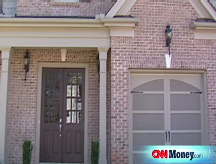
| Dodi Christiano and her husband, Paul Waldrop, had to slash their house's selling price by $100,000 to get a buyer. |

(Money Magazine) -- Last year Rick and Suzanne Pepin moved from the four-bedroom 3,400-square-foot house in Minneapolis where they lived with their three (now grown) kids to a luxury condo that's a third smaller and offers only a Murphy bed for guests. Still, the couple couldn't be happier.
"The location of our old home dictated that we drive to the grocery store, pharmacy and cleaners," says Suzanne, 57, a retired lawyer. Their new digs are across the street from Whole Foods and within easy walking distance of other stores and restaurants. They love the low-maintenance life.
"We have no worries about upkeep. No worries about lawn care. No worries about snow removal," says Rick, 68, also an attorney.
Maybe you too have caught the bug. After decades of hankering after the most expensive and enormous house you could afford, owning a smaller place is starting to look appealing.
Imagine the possibilities! You could move into a posh new condo with everything from a fitness center to a concierge - or into an energy-efficient little cabin on a lake Your commute could be shorter, giving you time in the evening to do something more than watch TV like a zombie.
And, maybe, just maybe, downsizing could save you some dough. Chuck Petitti, a Boston-area real estate agent, says many of his clients right now are empty-nesters who realize, "Hey, I could be traveling or doing something else with all the money I am paying for utilities and property tax on this big house."
If that's what you're thinking, you're by no means alone. A 2006 survey by Hanley Wood, a market research firm, found that 58% of affluent baby boomers say they are very likely or somewhat likely to move to a smaller home within the next 10 to 15 years.
And therein lies a big fat problem. With millions of boomers competing for smaller homes, you may find it hard to catch a break on price. Even though the downsizing trend is in its infancy, over the past five years smaller homes (under 1,200 square feet) have shown a greater rise in value than larger houses (over 3,000 square feet) - 5.2% a year as opposed to 3.5%, according to Zillow.com.
On top of that, you have to get money out of your old house - not an easy proposition with prices in the 20 largest metropolitan areas down 18.4% from their July 2006 peak, according to the S&P/Case-Shiller index. As of July there was an 11-month backlog of existing homes on the market nationwide. The happily downsized Pepins have yet to receive an offer close to the $1.25 million asking price on their old home.
What's more, smaller isn't necessarily cheaper. Depending on where you move, you may face carrying costs that are as high as or even higher than you pay now.
The trade-offs are complicated. You may cut gasoline costs by moving closer to your job in the city and using public transportation, but those savings could be eaten up by costlier car insurance. You could move to a small condo nearby but be unprepared for the dues and fees that condo living entails.
So you have to plan carefully, sizing up the finances underlying both new and old houses, or the savings you're counting on could be skimpier than you anticipate.
To start you need a clear-eyed assessment of the two markets that make up your downsizing, the one in which you're selling and the one in which you plan to buy. A real estate agent can give you an idea of your home's value, but you should also check how much houses in your area are selling for on Zillow.com, which lists sales prices of comparable houses.
Hanging on to past high prices only delays a sale. Dodi Christiano, 55, a psychotherapist, and her husband, Paul Waldrop, 56, a producer of TV public-service announcements, put a price of $850,000 on their 4,000-square-foot Fairfax, Va. colonial last year - about what nearby homes had fetched a couple of years earlier.
For six months they received nary a nibble. Finally, after slashing the price by more than $100,000, they were able to sell. "We had to face the fact that not everybody loved our home as much as we did," says Christiano.
You can't assume that a home's price is simply a function of its square footage. The national median sales price for condominiums, which are typically smaller than single-family houses, is now 5% higher than that for houses, according to the National Association of Realtors.
If you hope to reduce costs dramatically, you may have to buy your new place in another town or state. Think Decatur, Ill. or Mishawaka, Ind., where single-family houses cost just $79,400 and $80,900, respectively.
George Pollock, 67, a retired engineer, and his wife Marian, 66, wanted to get rid of the mortgage on their house in suburban San Francisco. Pollock worried that if he died before his wife, she wouldn't be able to meet mortgage payments with the 50% portion of his pension that she would receive.
No matter how much they shopped, however, they couldn't find a place they could afford in the Bay Area (median price: $701,700) without a mortgage. So they moved to much less pricey Sacramento (median price: $258,500), where their two grown children live. There they bought a 1,400-square-foot home for $380,000, leaving them with nearly $250,000 extra.
Says Pollock: "My wife is closer to the kids, and I know she has long-term financial security."
Buying without taking out a mortgage would certainly reduce expenses. At the very least you should look for a house whose price is low enough to allow you to buy with a mortgage that's smaller than what you have now.
If you're at or near retirement, taking on a new 30-year mortgage is overwhelming. You may be long gone before you can repay. Consider one with a 15-year maturity; the payments may look daunting, but you will save money. The interest rate is only about 0.10% lower than that of a 30-year mortgage, but over the life of the loan, you would save about $141,000 in interest.
Another option: Take out a traditional 30-year fixed-rate loan that does not charge a prepayment penalty. Then just send in extra payments each month as if you were on a 15-year repayment plan. You'll be saving by paying the mortgage off quicker, but if you run into unforeseen financial trouble, you'll be able to make lower payments.
Runzheimer International, a management consulting firm, estimates average annual savings of $1,300 in utility costs and $2,600 in property taxes from down-sizing from a 2,800-square-foot house to one with 1,800 square feet.
But the devil is in the downsizing details: You need to crunch the numbers to calculate your net savings. Start by totting up the annual cost for ongoing expenses such as property tax, utilities, lawn service and snow removal. As you shop for a new place, you should be gathering comparable information.
Other potential cost savings: If you move from suburb to city, you may be able to ditch one of your cars and its trailing expenses - insurance, financing, taxes, maintenance and fuel. If you gave up your 2006 Honda Accord, for example, you'd save nearly $26,000 in the first five years, according to Edmunds.com.
On the other hand, some costs could rise. In a condo or a house that is part of a homeowners association, there are monthly maintenance fees, and every so often you'll be on the hook for assessments to replace the roof or carpet the lobby.
Before buying, ask how much fees have risen over the past five years and whether new assessments are in the offing. If your new place is appreciably smaller, make room in the budget for new purchases to replace an oversize sectional or a king-size bed that won't fit.
Tempting as a pristine new condo looks next to your drafty old five-bedroom Victorian, don't plop down earnest money until you have a buyer with solid financing. Otherwise you could get stuck with two mortgages, two property tax bills and - well, you get the idea.
At least have your lawyer include a contingency clause in the sales agreement that obligates you to close only if you manage to sell your home by a set date. In the bubble-licious sales frenzy of yesteryear, sellers could make bidders do somersaults and had no incentive to agree to such a clause. But with so many homes on the market for months, sellers may now show mercy.
- Don't price your house like it's 2006. Paul Waldrop and Dodi Christiano of Haymarket, Va. asked the same amount that nearby houses had sold for two years earlier. "We had to realize that what had happened during the boom was not the norm. It took six stressful months to sell," says Dodi.
- Get the old place sold first. Rick and Suzanne Pepin of Minneapolis moved into their dream condo but now can't sell their house. "Don't wait to put your home on the market if you decide to buy. We waited for renovations on our new condo to be complete, and by then we couldn't sell," says Rick.
- Plan for smaller rooms. John and Polly Smart of Houston had the wrong stuff. "Smaller rooms may not accommodate your old things. We spent about $20,000 on new furniture and more on a smaller Silverado because the old one stuck about two feet out of the garage," says John.
Do you (and your spouse) make more than $170,000 annually and worry about tax-efficient retirement planning? If so, send your name, age, occupation, income and questions, along with a recent photo, to makeover@moneymail.com. We will be providing advice to a family in this situation in an upcoming article - and it could be you! 



