
Why disabled techies rock
TecAccess has found a lucrative niche connecting disabled workers with high-tech job opportunities.



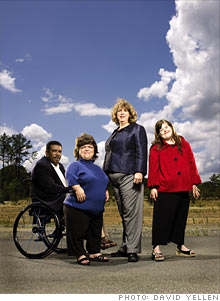 |
| Debra Ruh, with daughter Sara (right), finds tech jobs for workers like Raymond Kenney and Loretta Chittum. |


(Fortune Small Business) -- At age 20, Mark Loeffler was a former high school jock who worked as an hourly laborer at a tropical plant farm in Hawaii. Then one afternoon, vacationing with his parents at a lake in Michigan, Loeffler dove off the end of a dock and snapped his neck.
"I couldn't rely on brawn anymore," says Loeffler. "I had to get technical skills."
Now 43, Loeffler is an engineer, working as a contractor for the Department of Education in Washington, D.C.- with an assist from TecAccess, a small business that places disabled workers in technology jobs.
Based in Richmond, TecAccess also consults with organizations all over the world that want to make their hardware, software, and websites more accessible to the handicapped.
Founder Debra Ruh knows that technology developed for disabled users often winds up benefiting the general population.
"Closed captioning on televisions is a great example of something originally for the disabled that we now all take for granted," Ruh says. "It was developed for the hard of hearing. Now it's used in airports, bars - everywhere."
Similarly, voice-recognition technology was originally created for users who couldn't type. Now it's hard to navigate a phone system at a major company without coming across it.
Before Ruh started TecAccess, she divided her time between running the IT department of a local bank and volunteering in her daughter Sara's classroom. Sara was born with Down syndrome, and Ruh taught Sara's sixth-grade special-needs class how to create computer games. That's when she realized how digital technology could empower the disabled population.
"Accessibility used to be about building ramps," Ruh says. "Now it's about building ramps to technology."
After the bank laid Ruh off, she liquidated her 401(k) and savings accounts to launch TecAccess. At 49, Ruh has an easy laugh, a motherly persona, and a sharp business mind. She set up TecAccess as a for-profit firm, though many of her competitors, such as the Job Accommodation Network, are nonprofits. "We didn't want to be marginalized," she says. "We wanted to emphasize that this is good for business."
Ruh recruits mainly in the disabled community: Current staffers live with handicaps that include quadriplegia, cerebral palsy, and various mental health issues. Many employees work from home, using adaptive technology such as keyboards that can be operated with only one hand.
Since March 2000 the company has been selling technology consulting services to government agencies and corporations. That means, for example, helping the client develop a website that blind people can navigate using software that reads text but not graphics. TecAccess advises clients to place descriptive captions underneath pictures so that the screen reader can pick them up. Who better to evaluate the result, Ruh thought, than a blind employee?
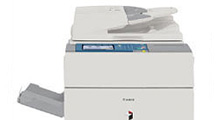
As the company grew it expanded into equipment testing and gained larger clients. In 2003, Canon (CAJ) hired a TecAccess team to help make its photocopiers more accessible. The team's advice: Provide voice-recognition capability, so users who are blind or cannot use their arms could still speak their commands to the copier. The result: Canon's ImageRunner series with a voice operation kit, which won an award last year from the American Foundation for the Blind.
"That allowed us to remain competitive in the marketplace," says Aubrey Woolley, Canon's government policy and compliance analyst, "particularly with government customers who focus on accessibility."
In addition to her consulting business, Ruh estimates that she has found technical engineering jobs for hundreds of disabled techies in the past year. Half of them, like Loeffler, are contract workers employed by TecAccess and placed with the client.
Some clients fear the expense of making the necessary workplace accommodations, such as buying special keyboards or chairs, that are required by the Americans With Disabilities Act. But Ruh says that the most she ever asked a client to spend is $2,000 for screen-reading software. According to a 2005 Department of Labor study, 59% of employers that hire disabled workers don't need to spend anything to meet ADA requirements. The median investment: $600.
Ruh says the expense is more than offset by higher productivity and retention rates. Annual turnover for her 35 full-time employees averages 1%, compared with a national average of 23%. Many clients agree.
"In some cases employees are more motivated if they're disabled," says Scott McKay, CIO at Genworth Financial (GNW, Fortune 500), who has used TecAccess to source both contract workers and staff employees.
A recent study by Virginia Commonwealth University rated disabled workers the same as or better than nondisabled co-workers on attendance, punctuality, task consistency, and work quality. And disabled workers scored only slightly lower on work speed.
"Managers say they want their workforce to be creative," Ruh says. "Well, these are people who have to think creatively every day. The world isn't made for them. They have to figure out how to get into the restaurant or how to reach the bathroom on the second floor. These are trained problem solvers with the minds of engineers."
Ruh's profits have grown every year except 2006, when she weathered a growth spurt without raising any additional capital. She projects revenues of $4 million this year. Just as satisfying: being named one of the Small Business Administration's top ten success stories in 2008.
Not content with that, Ruh is now focused on placing wounded Iraq veterans. She has trained 30 disabled vets so far and has found jobs for half of them already.
Mark Loeffler had to wait years to get the training he needed. His successors can launch high-tech careers in months. 
Opening New Worlds gallery: Check out these gadgets developed for the disabled that have gone mainstream.
A buzz about honey: A disabled son's obsession spawns a thriving family business.
Vision quest: How an entrepreneur turned a potentially crippling disability to his advantage.
A disabled CEO's $2 million innovation empire

-
 The Cheesecake Factory created smaller portions to survive the downturn. Play
 -
 A breeder of award-winning marijuana seeds is following the money and heading to the U.S. More
 -
 Most small businesses die within five years, but Amish businesses have a survival rate north of 90%. More
 -
 The 10 most popular franchise brands over the past decade -- and their failure rates. More
 -
 These firms are the last left in America making iconic products now in their twilight. More








 My dream is to launch my own business someday. Now that it's time to choose a major, I'm debating if I should major in entrepreneurial studies or major in engineering to acquire a set of skills first. Is majoring in entrepreneurship a good choice? More

 When it comes to in-flight pampering, the amenity kits offered by these 10 airlines are the ultimate in luxury More
 From a text therapy platform to apps that push you reminders to breathe, these self-care startups offer help on a daily basis or in times of need. More
 From Uber's flying cars to the Hyperloop, these are some of the neatest transportation concepts in the works today. More
 More Small Business


