
Nearly 25% of U.S. fuel production shut
14 of 26 Texas refineries, producing about 3.8 million barrels of fuel a day, are shut down after Hurricane Ike hits the state's refinery base head on.



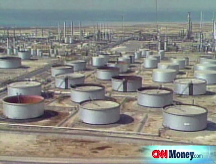


NEW YORK (CNNMoney.com) -- Nearly a quarter of U.S. fuel production was shut down in the wake of Hurricane Ike, according to a government assessment released Saturday after the storm slammed into the heart of the Texas coast's refinery base.
By noon ET, 14 of the 26 Texas refineries, representing a production capacity of 3.8 million barrels of fuel a day, had been shut down, the Energy Department said.
Almost all of those had been shut ahead of the storm and reports about the extent of damage were not yet available.
But even if the refineries were lucky enough to escape damage from the hurricane that came ashore at Galveston, Texas, early Saturday, they could remain shut due to near total power outages in the area.
Texas accounts for more than a quarter of the nation's total capacity to produce gasoline and other petroleum fuels. In normal operation, facilities there can produce up to 4.8 million barrels a day, according to the government.
About half of the state's capacity is in the Houston/Galveston area, which took the brunt of the storm. The eye of the hurricane passed directly over the ExxonMobil (XOM, Fortune 500) refinery in Baytown, Texas, the nation's largest refinery.
CNN correspondent Ali Velshi reported Saturday morning that there was no apparent damage to the refinery that could be seen from outside it, despite extensive damage in Baytown.
Kevin Allexon, spokesman for ExxonMobil, said the company has yet to determine if there is damage that could further disrupt operations.
"There's still some pretty significant weather that affects how safe it is to do assessment work," he said.
Velshi said that the Baytown refinery appeared to be on high enough ground to avoid flood damage. But refining facilities on land are more vulnerable to flooding and power outages than offshore facilities, according to Ray Carbone, president of oil trading company Paramount Options.
"Without power, no refineries will be working and the flooding could complicate how long it takes them to come back online," said Carbone.
The Energy Department reported that 2.4 million utility customers are without power, including essentially all those customers in the center of the storm's path. While refineries have auxiliary power, it is typically for emergency use only and not enough to resume operations.
"Close to 20% of the U.S. refining capability could be lost for a long period of time," wrote Jim Rouiller, Senior Energy Meteorologist at Planalytics in an email ahead of the storm. "Major and long term damage likely at the major refining cities from Galveston and Texas City northward to Baytown," he wrote.
After Katrina, some refineries were shut down for 6 to 9 months, according to Tom Kloza, chief oil analyst for Oil Price Information Service.
All Texas ports from Freeport west to Louisiana were closed Friday as well, according to the Energy Department.
Much of the nation's Gulf infrastructure had already been shut down or operating at minimal capacity due to Hurricane Gustav, which struck over Labor Day weekend.
However refineries in Louisiana that had been shut down due to the previous storm were in the process of re-starting or were already operating, the Energy Department said.
The refinery shutdowns drove up gas prices in the region.
The average gas price nationwide jumped nearly 6 cents in the Saturday survey of 5,000 stations, conducted Friday by AAA. But some markets, particularly along the Gulf Coast and the South, saw much sharper price spikes.
Pipelines: All of the major crude and natural gas pipelines flowing out of the region had been completely or partially shut ahead of the storm and remained shut Saturday, according to DOE. The approach of Ike has caused many pipelines to declare "force majeure," which frees them from delivery obligations in case the worst happens.
28 of the 39 natural gas pipelines in Ike's path were confirmed shut down by the Energy Department Saturday, up from 20 that had been shut in advance of the storm. That reduced capacity by 13.5 billion cubic feet per day, an increase of 3 billion cubic feet from those shutdown ahead of the storm. The shutdowns include facilities already in stand-by mode as a result of Hurricane Gustav.
The government also shut down Strategic Petroleum Reserve sites at Bryan Mound and Big Hill, Texas, and West Hackberry, La.
Offshore rigs: Evacuations also continued from oil rigs and platforms in the Gulf of Mexico, and from parts of coastal Texas, including Galveston and parts of Houston.
Also Saturday, the Minerals Management Service reported 611 production platforms, or more than 85% of the 717 platforms in the Gulf, had been shut down. That's up from the 562 that had been shut Thursday in advance of the storm.
In addition, 101 of the 121 rigs had been evacuated, up from 93 Thursday.
Many of the facilities were in the process of being restarted after Hurricane Gustav.
But experts said the major impact of the storm on energy prices is likely to come from the effect on refining capacity and pipelines, rather than offshore production.
Catherine Clifford, CNNMoney.com staff writer, and Chris Isidore, CNNMoney.com senior writer, contributed to this report. 



