
'Sobering moment'
Warnings of an economic calamity led lawmakers to tackle a giant bailout.




NEW YORK (CNNMoney.com) -- Somber. Sobering. Warnings of an economic "meltdown."
That's how participants described an emergency meeting held Thursday night between leaders of Congress and Treasury Secretary Henry Paulson and Federal Reserve Chairman Ben Bernanke.
The meeting was followed by an announcement from Paulson that he was preparing a far-reaching program - on a scale seen rarely in American history - to intervene in the shaky financial markets.
Paulson gave few details, although the plan's broad outline is for the federal government to buy hundreds of billions of dollars' worth of mortgage assets held by banks, Wall Street firms and other financial institutions. The Bush administration sent its proposal to members of Congress late Friday, according White House spokesman, Tony Fratto.
"Secretary Paulson and his team will continue their discussions with Congress and staff throughout the weekend, and we're hopeful that good progress will be made," Fratto said.
What did emerge clearly, however, was a surprising public show of unity by many lawmakers from both sides of the aisle who pledged cooperation to work on a solution with Bush administration officials with whom they often spar.
Official Washington - administration officials and legislative leaders alike - was clearly spooked by the events of the past week and what they heard from Paulson and Bernanke.
"I've never been in a more sobering moment in my 28 years with the language that was used - careful language - by the financial leaders of the ... country," Senate Banking Committee Chairman Christopher Dodd, D-Conn. told reporters on Friday.
Added House Financial Services Chairman Barney Frank, D-Mass., in an interview on C-SPAN: "We're not just talking about somebody on Wall Street losing money. ... We were in danger of there being enormous damage to the financial system."
One major concern: Wall Street firms were in danger of not being able to meet requests for redemptions from normally safe money market funds in which investors expect to get back at least as much as they put in.
This week alone, investors took out $210 billion from money market funds, with the bulk of those withdrawals coming on the heels of news that one fund had "broke the buck" - meaning its shares fell below $1.
On Friday morning, the Treasury said it would insure up to $50 billion in money-market fund investments at financial companies that pay them a fee to participate.
And on Friday, a conference call in which Paulson and Bernanke briefed House GOP members struck a similar tone, according to GOP aides who were on the call.
"The call was very sober, very strong on seriousness and very vague on details," one aide said.
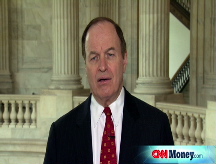
The potential cost of the plan - as high as $500 billion according to leading Republican Senator Richard Shelby, R-Ala. - has raised a lot of concern. But apparently not as much as the concern raised by not doing anything.
"Chairman Bernanke made all too clear the cost of inaction. When I heard his description of what might happen to our economy if we failed to act, I gulped," said Sen. Charles Schumer, D-N.Y. "Everyone put aside their partisan differences and agreed to work together to pass something to address the state of our economy."
Schumer told CNN that while the rescue will be expensive, "the only salvation is it would cost even more" to do nothing.
Senate Budget ranking member Judd Gregg, R-N.H., told the National Journal's Congress Daily that when it came to the potential cost of plan, the choice is to "either put up the money now, or allow the [financial] system to unwind."
"The economy is slowly being strangled," said Lyle Gramley, a former Federal Reserve governor. The administration's case-by-case handling of the crisis so far hasn't worked, he said, "because it hasn't dealt directly with the principle problem, which is a lot of bad mortgage debt."
Banks are having a hard time raising capital because no one knows how to value the mortgage assets on their books. So they're reluctant to lend. Indeed, the flow of credit to consumers and businesses fell 40% in the first quarter and another 35% in the second quarter, Gramley said.
"We've been in a credit crunch that's getting worse," Gramley said. "Businesses can't borrow, which means they can't invest." And if they can't invest, they can't keep people employed.
In the end, the chaotic events in the market this past week convinced President Bush that it was time to act.
"Our system of free enterprise rests on the conviction that the federal government should interfere in the marketplace only when necessary," Bush said. "Given the precarious state of today's financial markets - and their vital importance to the daily lives of the American people - government intervention is not only warranted, it is essential."
CNN's congressional producers Ted Barrett and Deirdre Walsh and correspondents Kate Bolduan and Kathleen Koch contributed to this report. 



