
California's cash crunch: IOUs coming
Golden State won't be able to meet payments until new budget accord reached.




NEW YORK (CNNMoney.com) -- The world's eighth largest economy is on the verge of issuing IOUs.
Suffering from both a $15 billion budget deficit and a multi-million dollar cash shortfall, California is days away from not having enough money to cover all of its bills.
Starting on Sunday, state controller John Chiang plans to delay sending state tax refund checks, payments to contractors and disbursements to counties and agencies that provide social services. He estimates that the state will be at least $346 million short in February.
"Rather than helping stimulate the economy, withholding money from Californians will prolong our pain and delay our economic recovery," he said. "Individuals who already are vulnerable will be hit hard."
Gov. Arnold Schwarzenegger and legislative leaders are behind closed doors trying to hammer out a solution to the state's mid-year budget crisis and a projected $25 billion gap for 2009-2010. The governor has proposed draconian spending cuts in virtually every department, as well as hefty tax increases, to close the widest deficit in its history.
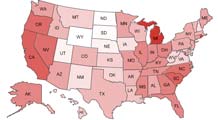
California is not alone in its budget troubles. Some 46 states face budget shortfalls, forcing them to slash funding for many services. But California is the largest state in the union, and its problems are particularly severe. Its deficit totals more than 35% of its general fund.
Some 257,400 jobs in the Golden State evaporated in 2008, pushing the unemployment rate up to 9.3% in December, the fourth highest nationwide. Its median home price plunged nearly 50% since the spring of 2007.
Meanwhile, the demand for assistance has risen. The number of Californians receiving food stamp benefits increased by 13.8% for the year ending September 2008, while the number of families receiving cash assistance from the CalWORKs welfare program rose by 5.9%, according to the California Budget Project.
The state's fiscal troubles largely stem from its heavy reliance on personal income taxes. This revenue stream dries up when recessions hit and unemployment soars. California also never fully recovered from the dot-com bust earlier this decade, which led to big budget problems at the time. So the state didn't have large reserves to fall back on when the bottom fell out of the economy.
"We went into this downturn in a very weak position," said Jean Ross, the California Budget Project's executive director.
On top of its economic troubles, the state is also coping with a near shutdown of the nation's government bond markets, which had allowed it to borrow to cover its short-term debts. This fall, the state was only able to borrow half of what it needed to see it through the fiscal year.
The lack of access to the bond markets prompted the state in December to suspend funding for more than 2,000 infrastructure projects, leaving many people and businesses without much-needed work.
And because of California's financial woes, credit rating agencies are taking a dim view of the state. Moody's warned in mid-January it might downgrade California's general obligation bond rating because of its budget and liquidity problems. If this happens, it will become even costlier for California to borrow.
To shore up California's budget, the governor wants to slash spending by $17.4 billion, according to the California Budget Project.
The cuts include:
- $7.7 billion from public education
- $322.9 million from the community college system
- Eliminate dental and other benefits for adults on Medicaid
- Cut monthly grants to low-income families by 10% and restrict eligibility for cash assistance
- Cap payments to attendants working for the In-Home Supportive Services program
- Require state workers to take two unpaid days off per month.
"It will involve pain for Californians," said Jerry Nickelsburg, senior economist at UCLA Anderson Forecast. The state "just doesn't have the money to cover all the spending that's been approved."
Schwarzenegger is also looking to boost revenue by $14.3 billion and borrow $10 billion more.
His fundraising measures include:
- Raising state sales tax by 1.5 points - to 8.75% - through the end of 2011.
- Broaden the tax base by levying state sales taxes on appliance and car repairs, vet services, sporting events and golf
- Raise alcoholic beverage taxes by a nickel a drink
- Increase vehicle registration fees by $12 per car and driver's license fees by $3.
"The truth is that California is in a state of emergency," Schwarzenegger said in his State of the State address on Jan. 15. "The $42 billion deficit is a rock upon our chest and we cannot breathe until we get it off."
To conserve whatever cash remains to fund education and meet debt obligations, the state's controller plans to delay other payments or issue IOUs, which the state hasn't done since officials failed to pass a budget in 1992. This could mean thousands of businesses and millions of people will be left hanging until a budget plan is hammered out.
The controller was also going to delay payments to more than a million elderly, blind and disabled residents who receive the state's supplement to Social Security benefits, but the federal government said it would cover the difference. Likewise, colleges said they would make up for delayed student aid grants that would also be affected.
Some relief may be coming California's way. The state stands to receive billions from the $819 billion stimulus package that just passed the U.S. House of Representatives.
The state could get as much as $63.4 billion, some 12.3% of which could be used to balance the budget, according to the Center for American Progress. Some $3.6 billion could go for highway construction and transit improvements, restarting some of the projects currently idling. California will also receive billions to pay for education, Medicaid and other benefits.
Schwarzenegger, however, says the state must still work out its own budget problems.
"I always make it clear that we will not use that money to bail us out, because we have to bail ourselves out," he said in a speech this week. "I think we have to be careful not to look at them [the federal government] as the savior, but to just look at them as the icing on the cake." 



