
$100 billion jolt of 'green stimulus'
A big chunk of the nearly $900 billion economic rescue package may go to alternative energy and environmental projects. Who will benefit, and is it enough?



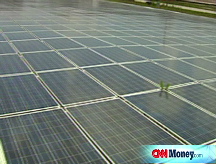

NEW YORK (CNNMoney.com) -- A short-term booster shot for the economy? Or a complete rethinking of the way businesses and individuals consume energy?
Those are the crucial questions as Congress debates the more than $100 billion in initiatives that are currently part of the nearly $900 billion stimulus package.
As it stands, the bill would use tax cuts and government spending for a wide range of projects - everything from building wind farms to helping you replace your energy-hogging refrigerator.
The plan has critics on both sides.
Some say the spending will take too long to kick in to really help the economy, and that the government is making decisions that are better made by the free market.
Others say it doesn't go far enough: If the country is serious about ditching its dependence on oil, the thinking goes, it's got to pony up more cash to develop alternatives.
Still others say it's just about right. "We're happy," said Greg Jenner, a tax attorney at the law firm Stoel Rives, who helped parse some of the language in the bills. "It's a good first step."
The House passed its version of the bill last week, and debate in the Senate has just begun. The two bills are similar when it comes to green issues.
Here's where the money's slated to go:
Conservation programs: ($24 billion House, $15 billion Senate) -Conservation is the biggest single part of the green plan, largely because many of the projects can be done quickly and employ out-of-work construction types. For example, $12 billion would go toward the upgrade of federal buildings and low- and middle-income homes. Upgrades would include replacing windows and adding insulation.
These changes are "low hanging fruit," easy ways to save lots of energy. The House version allocates $300 million to fund rebates for people to buy new efficient appliances. These can save up to 30% more power than traditional models, according to the Alliance to Save Energy.
Public transportation: ($13 billion House, $8.5 billion Senate) - This money would go toward discouraging driving, by building train lines, adding new bus routes and upgrading existing systems.
The House version originally only slated $10 billion for this, but was increased after protests from some lawmakers. The Senate version currently has slightly less money allocated for public transportation.
Renewable energy loans: ($10 billion Senate, $8 billion House) - These work like outright grants for various renewable energy and transmission projects in the early stages of development. They could include wave power, geothermal, offshore wind or innovative solar projects, as well as more traditional renewable energy projects.
Power lines: $6.5 billion - The nation has a shortage of power line capacity, as witnessed by the blackout of 2003 that hit the Northeast and Midwestern states.
It also needs more lines to transport renewable energy from the sparsely populated areas where it is most prevalent - like wind on the high plains and solar in the desert - to cities.
Nuclear waste cleanup: $6.4 billion (Senate) - This would pay for cleanup at old nuclear weapons facilities.
Smart grid: $4.5 billion - This is a small fraction of the money required to digitize the power grid, making it more efficient and better able to handle renewables.
The money would be used for matching grants to utilities and to set up pilot programs in select cities.
Advanced vehicle grants: $3.2 billion - More than $2 billion is slated for loan guarantees to companies developing batteries for electric cars. Many say electric vehicles are what will ultimately move the nation away from oil, but developing a suitable battery remains the main hurdle.
National parks and public land improvements: $3 billion - This includes money for better access roads, facilities and trails, as well as various environmental cleanup efforts on public land.
Environmental cleanup: $1 billion (Senate) - This would pay for additional cleanup up at old industrial sites and other areas currently monitored by the Environmental Protection Agency.
Large-scale wind projects: $13 billion - This is a three-year extension of the tax break for big wind projects, which essentially provides wind power with a subsidy of around 30%.
The current tax credit needs to be renewed every year. Supporters say the 3-year extension will provide much needed stability to the market, and result in more wind farms being built.
Large-scale renewable projects: $11 billion - The Senate version lets companies take a "carry-back" - a tax credit against prior profits. That's an important incentive for many business that invest in renewable energy, which like banks, are not currently making money.
The $11 billion tax credit would apply to all industries, not just renewable energy. The renewable energy sector is expected to take a big chunk of this money.
The House version also has the "carry back" provision, plus it allows for direct grants from the Energy Department worth 30% of the value of a renewable energy project, a potential boon to new companies that don't have past profits.
The industry has been arguing for something even more generous - a so called "refundablilty" clause that's similar to the DOE grant but relies on the Internal Revenue Service for the money.
There's been some opposition to the grants and refundability proposals in the Senate. Some claim that money will be given to companies that don't really need it. As the bill continues to be debated what the final version will look like remains to be seen.
Home conservation: $4.3 billion - Homeowners are eligible for a tax credit for part of the cost of various efficiency measures like replacing an old furnace or adding better insulated windows. The dollar amount of the credit for each item (furnace, windows, etc.) is currently capped at various levels. The new bill would remove these individual caps and allow for a 30% tax credit on all items. The value of the tax credit is capped at $1,500.
Renewable energy and conservation bonds: $1.5 billion - This lets local and state governments raise money for renewable energy and conservation projects by issuing bonds backed by the federal government.
Renewable energy manufacturing: $1.4 billion - In the Senate version only, this would let companies that make renewable energy components - like wind turbines or solar panels, receive a tax credit of 30% of their new investments in plants or machinery.
Small-scale renewable tax credits: $1 billion - Currently, if you buy a small windmill for your backyard, a solar hot water heater or a geothermal heating system you can write off 30% of the cost on your federal tax bill, capped at $2,000 for the heating systems and $4,000 for the wind turbine. This bill removes those caps, although the 30% limit remains. 



