Living it up in retirement
Dean and Marion Snyder moved to a place with a concierge, pool, putting green, fab food - and health care for life. What you should know about an increasingly popular way to retire.



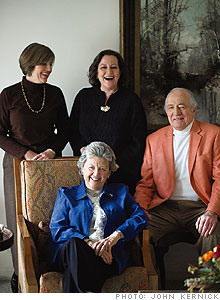 |
| Marion and Dean Snyder - here with daughters Susan and Gayle - moved to Beaumont in 2004. And the whole family couldn't be happier. Says Gayle, "Our parents are thriving here. And it's a blessing to us, knowing they're secure and happy." |
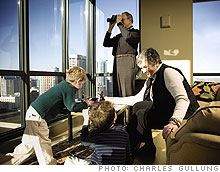 |
| Ned and Priscilla Lange moved to Horizon House in Seattle in December of 2007. The couple had parents who lived in CCRCs and knew they'd always be taken care of. "We wanted to give that gift to our children," says Priscilla. |
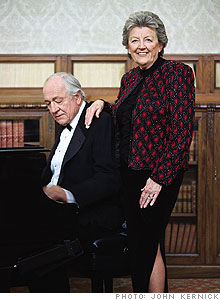 |
| Dean and Marion Snyder moved to Beaumont at Bryn Mawr in Bryn Mawr, Pa. in 2004. "It's like living in a country club," the couple says. |
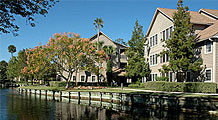
(Money Magazine) -- There's retirement living, and then there's living it up in retirement. The latter is part of the draw of one of the fastest-growing retirement options - the continuing-care retirement community. These CCRCs, as they're called, often look a lot more like four-star resorts than old folks' homes.
Amenities may include gourmet restaurants, infinity pools, gyms, spas and concierges. Pennsylvania's Beaumont at Bryn Mawr, home to Dean and Marion Snyder, has a cinema and a putting green.
But the greatest luxury of CCRCs isn't any of these. It's this: health care for life.
This type of community promises "aging in place," typically allowing residents to live independently as long as they can and giving them access to more care - on the same campus - when, and if, they need it.
The concept has taken off as consumer awareness has grown and developers have mastered the concept, says Kathryn Brod, senior living research director at Ziegler Capital Markets, an investment banking firm.
Private companies such as Classic Residence by Hyatt and Erickson Retirement Communities have helped up the amenities ante, making it even more appealing. Today there are 1,800 CCRCs nationwide, and they've been growing at a rate faster than nursing homes and assisted-living facilities combined.
As with any kind of housing these days, however, supply has recently begun out-pacing demand. That means now might be the best time in years to get into a CCRC (previously many had waiting lists), and get a deal (though it'll still be pricey).
So you might want to consider a continuing-care retirement community for Mom, Dad or even yourself. But you'll need to understand that these facilities aren't for everyone. The glossy brochure won't tell you everything you need to know, but we will.
A continuing-care community typically offers access to three levels of long-term care on one property, and residents can move between them as need be.
First is independent living, in which residents live on their own in an apartment, townhouse or house. The idea is to move in while still healthy - average entrance age is 79, according to Ziegler - and able to take advantage of the educational lectures, bike paths, water aerobics and the like.
Level two is assisted living, which provides help with daily tasks such as bathing and dressing. Level three is 24-hour nursing-home-style care. (You can find a list of facilities that follow the CCRC model at snapforseniors.com.)
Ask residents what they like most, and the phrase you'll likely hear repeated is "peace of mind." Those who move in have chosen for themselves where they'll spend the rest of their years. They know they'll always get the help they need. And couples are assured that they'll always be near each other, even if one person needs more care.
The facilities also provide a sense of community and a built-in support network. Plus, for adult children there's security in knowing that, once their parents move in, they're set - no worrying about finding a good facility in the midst of a crisis. Really, the amenities are just the cherry on the sundae.
That peace of mind will cost you. CCRCs usually charge an entry fee, and always a monthly fee. These vary widely, depending on how luxurious the place is, what size home you opt for, whether you're moving in alone or with a spouse, and how much future care is covered. In one way or another, you pay for your long-term care, "rent," housekeeping, and some meals.
The up-front cost, if there is one, generally runs from $20,000 to more than $1 million, and averages around $250,000, according to research group National Investment Center for the Seniors Housing and Care Industry (NIC). Usually, this doesn't buy property or equity, just a ticket in (more on this later).
As for monthly fees, one facility can offer several ways to pay. In some contracts fees remain steady no matter what stage of care you're in; in these, the average is $2,750 a month.
Other plans are la carte, in which case you might pay $2,500 for independent living and $7,000 to $8,000 for skilled nursing care (vs. an average $6,500 a month for a private room at a traditional nursing home, per Genworth Financial).
Some of the fees may be tax deductible. But still, assuming Mom remains in independent living for 15 years and pays $2,000 a month, she's looking at an outlay of $360,000 - plus entrance fee.
On top of that, she should budget for an annual 3% to 6% increase in the monthly fee, says Betsy Mayes, an accounting professor at University of North Carolina at Asheville who studies CCRCs. If it's a pay-as-you-go plan, and your parent needs nursing care, it'll come out significantly higher.
What's more, Mom will still have other living expenses - like phone service, entertainment and whatever medical costs insurance or Medicare don't pick up (say, co-pays on doctor visits). "So if it's a stretch to pay going in, it'll only get worse," Mayes warns.