Car dealers face extinction
The small, independent dealership is struggling to compete in an increasingly cutthroat auto market.



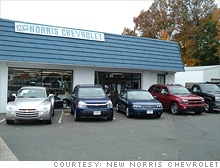 |
| New Norris Chevrolet, when times were better. |
Find your next Car


WESTFIELD, N.J. (CNNMoney.com) -- New Norris Chevrolet in Westfield, N.J., is gone now. Along with hundreds of other small dealers across the country, it was forced to shut down -- swept under by mounting debts, dwindling car sales and industry consolidation.
"I'm here all the time!" says owner Larry Friedman, on a video on the Web site of his now defunct dealership.
And he was there on a recent Wednesday afternoon, helping someone load a few chairs into a van as he sold the dealerships' remaining furniture and office equipment.
The father of two grew up in the business. Norris Chevrolet was founded in the 1920s, making it one of the oldest Chevrolet dealerships in the nation. His father, Mitchell, bought it in 1981, adding "New" to the name.
To hear Friedman tell it, his dealership had been doing a pretty good business before the economy turned sour. He sold maybe 50 cars a month in a normal year, about average for a dealer like New Norris, located far from an interstate highway.
"We were just a small, little dealer in town," Friedman said. "I'm not a highway dealer, selling a lot of cars."
But in late 2008 gas prices rocketed up, leaving him stuck with lots of big trucks nobody wanted. Then, in the fall, the banking system went into a skid. New Norris's customers couldn't get car loans and GMAC, which financed his own inventory as well as his customers' purchases, started demanding big payments on all those unsold trucks and SUVs.
GMAC would not comment on Friedman's case, specifically. In a statement released recently in response to concerns over dealership closures, the finance company said, "We work with dealerships facing financial difficulty that have GMAC loans, but cannot extend credit indefinitely if there is a default or a significant risk of loss."
A disappearing business model
In 2008, New Jersey lost about 60 car dealerships, or roughly 10% of its total dealership population, said Jim Appleton, president of New Jersey Coalition of Automotive Retailers. "We'll probably lose another 50 dealers this year," he said.
Nationally, the United States lost about 900 car dealerships last year, according the National Automobile Dealers Association. About 66% percent of the dealers that closed last year were single-brand dealers.
The losses are greatest among dealers selling Detroit brands, said Appleton.
"They're all suffering the same way. The problem is that it's much worse for domestic dealers," he said. "Volumes have dropped more substantially and access to capital as been curtailed more dramatically."
Friedman's loyalty to Chevrolet may have left him especially vulnerable. He sold nothing else. He had tried selling more popular foreign cars off his used car lot, he said, but his GM-trained technicians didn't know the cars well. So, even though used car buyers were paying more for high mileage Japanese cars, his used car sales were few, he said.
"Used car sales are the salvation for a lot of these franchise dealers," said industry analyst Art Spinella of CNW Market research.
Many new car dealers today sell about as many used cars as new and they sell them at much higher profit margins. Meanwhile, the new car showroom has become a source of used cars - as trade-ins - and of customers for service rather than a source of profit itself.
Big fish eat the little ones
Dealerships like Friedman's are becoming a dying breed. Consolidation has been an industry trend for a long time. While the decline in the number of dealerships was unusually large last year compared to recent years, according to NADA, the total number of car dealers has been declining since at least 1970.
Selling more brands under one roof, or at least owning more than one franchise, reduces risk as customer tastes change and more brands enter the market. The economic downturn seems to be speeding up that trend.
These days, as small dealers like New Norris are going out of business, dealership chains are taking advantage of the opportunity to buy more stores, said Brady Schmidt, president of National Business Brokers, a company that specializes in arranging the purchase and sale of car dealerships.
"Our business gets busier when times get tougher for car dealers," he said.
These days, there are fewer buyers for car dealerships, he said, but those that are still in the market are the strongest ones - the most likely to actually complete a deal.
NBB doesn't even bother to list many of the dealerships that approach the company looking to sell.
"We analyze literally thousands of dealerships a year to do those 40 to 60 deals a year," he said.
Stand-alone domestic dealerships, like New Norris, are a particularly tough sell right now, he said.
Exact figures are difficult to come by, said Spinella, but it is true that there are fewer single-brand businesses among auto dealerships today. A lot of that shift is driven by General Motors (GM, Fortune 500), he said, which is cutting and combining dealerships across the country.
Today, the average metro-area Chevrolet dealership sells about as many cars a year as New Norris Chevrolet did about a decade ago, when times were better, said Chevrolet spokesman Terry Rhadigan. That's about 750 cars a year.
That's not enough. GM wants Chevy dealers to sell almost double that number. That means having fewer dealers and placing those dealerships in highly visible, high-traffic locations. For instance, close to major highways.
The benefit for GM is that those fewer, more profitable dealerships will have the money to invest in expensive upgrades, like prettier showrooms and better lighting. They'll also be able to attract the best staff.
"The best salesmen in town should aspire to work at the Chevrolet store," said Rhadigan. 

-
 The Cheesecake Factory created smaller portions to survive the downturn. Play
 -
 A breeder of award-winning marijuana seeds is following the money and heading to the U.S. More
 -
 Most small businesses die within five years, but Amish businesses have a survival rate north of 90%. More
 -
 The 10 most popular franchise brands over the past decade -- and their failure rates. More
 -
 These firms are the last left in America making iconic products now in their twilight. More