An old engine learns new solar tricks
Could solar power and 19th-century engineering combine to help save Detroit?



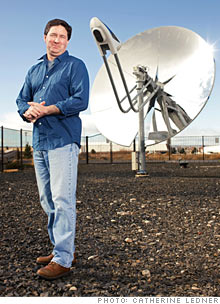 |
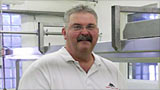
| J.D. Sitton, CEO of Infinia |
(Fortune Small Business) -- J.D. Sitton's mission was to find a new market for a 193-year-old engine that nobody wanted. His innovative answer: turn it into a solar power collector, then persuade top auto-parts suppliers - currently eager for work - to build it.
Sitton, an engineering industry veteran, had been recruited in 2002 to head Infinia, a struggling startup that developed high-tech applications for old-fashioned Stirling engines. The Stirling, invented in 1816 by a Scottish clergyman, runs on hot and cold air. As long as one end of the engine is kept hotter than the other - no matter what your source of heat - a Stirling will keep on pumping.
Six University of Washington professors founded Infinia in 1985 to commercialize their invention: a heart pump that used a tiny Stirling engine and would never need replacing. Unfortunately, the heat source was a small, shielded chunk of plutonium-238. Not the weapons-grade stuff, and perfectly safe inside its core - but the U.S. government withdrew vital funding, fearing that terrorists would start targeting heart patients.
Infinia launched several other ill-fated Stirling projects, including the power source for a NASA deep-space exploration probe that the agency has yet to build. So Sitton was called in to recruit a management team, find investors and carve out a market.
"The founders always had the idea that somehow they would find their way into the consumer market," says Sitton, 47. "But they never had sufficient cash to pull it off."
Sitton was impressed by the company's technology. Infinia's founders showed him their design for a solar-powered Stirling engine, with the heat provided by what looked like a large, mirrored satellite dish. The other end was cooled by a car-radiator system. A mechanical drive kept the dish pointed at the sun throughout the day. At night it folded up like a flower to help retain heat (with a small biofuel tank as backup).
Using the Stirling as a generator, Infinia could convert 24% of the sunlight hitting the dish into electricity - a better conversion rate than most solar panels have. Sitton needed no further convincing. He went hunting for investors just as the solar market was heating up. Since 2005 he has secured $70 million in funding from venture firms such as Vulcan Capital, owned by Microsoft co-founder Paul Allen.
Soon Infinia landed its first client: the U.S. Army. The solar generator was easy to disassemble and move around, and it didn't give off detectable heat like a diesel generator, making it perfect for combat operations.
Sitton's long-term plan is to build solar farms that can be hooked up to the electric grid just about anywhere it's sunny. His goal is to produce 100,000 Infinia Solar Systems in 2010, with an initial price of $15,000 each.
But how to manufacture solar Stirling engines in bulk? The solution soon became clear: use the engineering skills and scalable operations of auto-industry suppliers, many of which have been left idle by Detroit's decline. The industry has the capacity to build 17 million autos a year but turned out just 10 million last year. And because internal combustion engines are more complex than Stirling engines, auto suppliers can easily adapt.
Sitton contracted out the various solar-engine components to 60 engineering companies, mostly in the U.S. The most important pieces, the dish and the engine, are being manufactured by two top-tier auto suppliers, Autoliv and Cosma.
"Companies that wouldn't take our calls a couple of years ago are now pursuing us aggressively," says Gregg Clevenger, Infinia's CFO. "They want to focus on a growth industry rather than a shrinking industry."
The alliance seems like a natural fit to Gary Gereffi, a professor at Duke University who studies the solar industry. "All this technology is made up of regular parts that manufacturing companies are making all the time," he says. "The difference between our economy and a green economy is not as substantial as people think."
If Infinia scales up as quickly as it would like, it will create a miniature solar stimulus package, with technicians and construction and maintenance contractors flourishing in its shade.
"We can get to where we look attractive relative to the cost of coal plants," predicts Clevenger. "When that happens, there's no limit to the number of solar systems we can sell." 

-
 The Cheesecake Factory created smaller portions to survive the downturn. Play
 -
 A breeder of award-winning marijuana seeds is following the money and heading to the U.S. More
 -
 Most small businesses die within five years, but Amish businesses have a survival rate north of 90%. More
 -
 The 10 most popular franchise brands over the past decade -- and their failure rates. More
 -
 These firms are the last left in America making iconic products now in their twilight. More