

Are stocks a loser's bet?
Only if you attempt to sort out the handful of winners from the rest of the market.



 |
| William J. Bernstein is co-founder of Efficient Frontier Advisors and author of "The Four Pillars of Investing" and "A Splendid Exchange." |
(Money Magazine) -- Despite the recent rally, equities are still down more than 30% over the past year. So there's a good chance you're a lot poorer today than you were 12 months ago. And that means your faith in the stock market is still probably shaken.
In fact, I wouldn't be surprised if, after seeing the market go straight up for the better part of two decades, you're now starting to wonder whether stocks are prone to lose money over time.
Well, guess what? Most stocks do lose money over time.
It's a little-known and depressing fact, but the majority of individual securities tend to post negative returns over the long run.
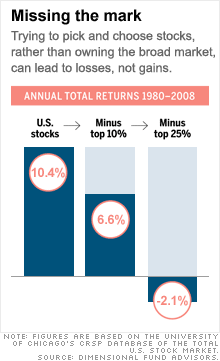
In fact, researchers at the investment management firm Dimensional Fund Advisors found that from 1980 to 2008, the top-performing 25% of stocks were responsible for all the gains in the broad market, as represented by the University of Chicago's CRSP total equity market database (see the chart at right).
As for the bottom 75% of stocks in the U.S. market, they collectively generated annual losses of around 2% over the past 29 years.
This may get you thinking: If a small list of securities accounts for the market's long-term returns, why not avoid all the headaches and losses you've suffered recently by carefully choosing these superstocks?
Simple: Because a portfolio of "carefully chosen" equities could easily wind up with none of the best-performing stocks in the market - and thus produce flat or negative returns over many years. Missing out on even a handful of superstocks can leave you short of your target.
Remember that the point of investing isn't to aim for the highest possible returns. It's to make sure you don't die poor. Yet trying to optimize your performance by seeking out the needles in the haystack is a sure way of becoming, well, poor.
Now, some investors and fund managers do wind up picking these winning lottery tickets in the stock market. But history shows that this ability doesn't persist over time.
Even if you're lucky enough to win with a concentrated portfolio of superstocks, after a while you'll find that most of your net worth is tied up in a handful of holdings - and that's a sure-fire prescription for chronic insomnia.
So what can you do?
Diversify as broadly as you can. With a small list of stocks, it's easy to miss out entirely on the top 10% performers. Doing so would have cut your annual returns to 6.6% from 10.4% over the past 29 years. Ouch! A $100,000 investment in 1980 would have grown to $1.8 million by 2008 at 10.4%. That same amount, at 6.6%, would have grown to only $640,000.
Don't give up on indexing. The only way you can be assured of owning all of tomorrow's superstocks (and super asset classes as well) is to own the entire market. So even though it's been a tough decade for the world's benchmarks, you're still better off owning a mix of total market index funds that cover U.S. and foreign stocks.
William J. Bernstein is co-founder of Efficient Frontier Advisors and the author of "The Four Pillars of Investing" and "A Splendid Exchange." 



