

The Koeman family
Rethinking a righteous aversion to wealth.




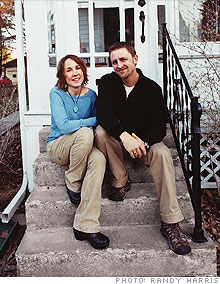 |
| The Koemans are finding a middle ground between their desire to give to others and their need to save for their future. |
| MMA | 0.69% |
| $10K MMA | 0.42% |
| 6 month CD | 0.94% |
| 1 yr CD | 1.49% |
| 5 yr CD | 1.93% |
(Money Magazine) -- Jodi Koeman remembers that when she was young, her parents, though always short on money, tithed to their church faithfully and joyfully. She recalls, "They'd always say, 'First, we're giving to the church. Then we'll figure out the rest.' "
Until recently that's the creed that Jodi, 40, and her husband, Kent, 41, lived by too. The Whitinsville, Mass., couple have built their lives around their Christian faith: Jodi leads the arts program and coordinates social services for their church; Kent teaches Bible studies at a private Christian school. Neither position pays very well.
But both spouses felt a certain righteousness in their financial struggles, believing the Bible teaches that wealth can distract one from God. Kent, the son of a pastor, cites Jesus' parable of a rich man who wants to build bigger storehouses to hold his wealth, only to be called a fool by God, who says he will die that very night. "I grew up thinking that wealth was to be avoided," says Kent. "My mistake."
The couple had no single aha! moment or loss of faith - just a growing weariness with the struggle to support themselves and their three children. Even after supplementing their income with second (and third) jobs, they've found it difficult to save for emergencies, much less to invest for key goals like retirement and a college education for the kids.
After spending years avoiding wealth and trusting that God would somehow provide, they now suspect they've endangered their family's financial future by not working harder to avoid poverty. Or as Kent half-jokes, "I got sick of being poor."
Certainly he gave it a shot. Married in 1991 (he and Jodi met at a college affiliated with their Christian Reformed Church denomination), he took his first job teaching English at a Christian school in the state of Washington. Starting salary: $14,000 a year. He could have earned more at a public school. But he wouldn't have been able to share his beliefs completely with his students. "It would be like getting almost the whole deck of cards - not quite everything," he says.
When they moved east in 1994 so that Jodi could get a master's in social work, Kent landed the job he still holds at the Whitinsville Christian School. The money wasn't important: Asked in his job interview about his compensation needs, he replied, "Hey, as long as I can pay my bills."
For a while, he could. Though the couple earned less than $50,000 (after getting her degree, Jodi went to work for a social services agency), by 1996 they were able to pay off her college loans. They also put a $10,000 down payment on their current home, one-half of a two-family house.
But over the next several years their income dropped as expenses grew. Jodi quit her job to care for a growing family - Jamison, now 11, Arianna, 10, and Hadley, 6. Their income fell to $30,000, and even paying their basic bills became a struggle. Still, they continued to give to their church, although at less than their traditional rate of 10% of their net income.
The couple worked hard, and their income slowly grew again. At one point, Jodi worked three part-time jobs, including organizing the Sunday service at the fledgling church she and Kent joined in 1997. Kent spent summers painting houses. Jodi's responsibilities and hours grew at church (she's up to 32 a week now).
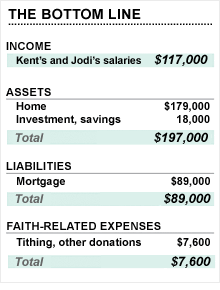
But the couple didn't really get any breathing room until two years ago, when Kent ditched the paintbrush and took a better-paying second job as a lab technician. The turnaround is dramatic: The couple now make $117,000 a year. They've even started saving, with $8,000 in Kent's retirement plan and $10,000 in the bank.
Finally, they can think more seriously about their financial goals. Jodi plans to start divinity school this year, and she and Kent also want to trade up to a single-family home. They'd like to pay for at least half of the children's college education and semi-retire by the time they turn 60.
"We used to feel that if we just did our jobs using the gifts God gave us, we would be taken care of financially," says Kent. Now they know it's up to them to take care of themselves.
To help the Koemans, Money arranged a meeting with Janice Swenor, a certified financial planner in Westminster, Mass. Her advice:
Set smart priorities. The Koemans' most pressing needs are to beef up their emergency fund and pay for Jodi's divinity school, which will cost at least $16,000 over four years. Currently they put $1,600 a month into the rainy-day fund. Swenor suggests that once the account hits $16,000 (equal to three months' living expenses) they redirect $600 or so a month into a separate savings account for divinity school. One goal that probably won't go as hoped: paying for half the kids' college costs; 30% is more realistic, Swenor says.
Kent and Jodi agree they should give other savings goals precedence over the children's education. "I had to pay for college on my own," says Jodi. "For us to be able to pay any part of tuition for our kids is a positive for me."
Stick tight to a budget. Thanks to Kent's generous pension plan at work, their dream of semi-retiring at 60 is a real possibility. But to seal the deal, they need to step up retirement contributions.
To do that, Swenor says, they need to cut spending by $300 a month. One way: Make monthly deposits into a dedicated savings account for expenses like gifts and travel; the amount in the account becomes the hard-and-fast spending limit for those items.
Jodi says they're already living frugally: "How much more can we tighten?" she asks. But a month later, she says they were able to swing it by cutting down on clothing and gifts, and eating out just twice a month.
Price the house right. The Koemans have their eye on a $338,000 home with a garage apartment on the property. They figure they'll end up with no change in housing costs, since the tenant's $700-a-month rent will offset their bigger mortgage payments. But Swenor says they're overlooking increased maintenance costs, plus a weakening rental market; the maximum they should pay, the planner thinks, is $285,000.
Kent and Jodi initially agree. But a few weeks later, they get an offer on their home, so they bid $320,000 on the house they want - and are accepted. "We're increasing our quality of life with the extra space," Kent says. "We'll make it work."
Jewish: The Perets Family




