

The return of volatility
You can still thrive in bumpy times - as long as you stick to a diversified plan.



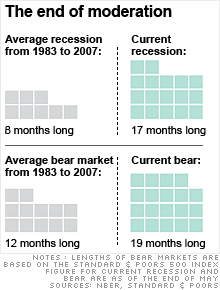
(Money Magazine) -- Old: Investing in the '80s and '90s sure was simple. The economy and stock market grew rapidly, and the occasional recession or bear market didn't last. True, the 2000-02 bear hung around, but it was followed by history's second-longest uninterrupted rally. And while triple-digit up or down days in the Dow weren't uncommon, the long-term trajectory of stocks became predictable. So much so that this era had its own name: the Great Moderation.
New: There's nothing moderate about the economy that's likely to emerge from this recession. For starters, many of the economic mega-trends that smoothed our ride are behind us: for instance, the quarter-century decline of interest rates that brought yields on 10-year bonds down from 15% to 3%, and the fall in inflation from 13% to nearly nil.
As rates and inflation inevitably rise, they're likely to stall the market - or jam it into reverse - more frequently and for longer periods than we've grown accustomed to. The current bear is already 19 months old, about the average length of the typical downturn since 1929. It - and not the three-month bears you saw in the '80s and '90s - will almost certainly be closer to the new norm.
You also live in a world that's got more, and more voluble, powerbrokers. In 1995, countries like China and India accounted for less than 17% of the world's GDP. Now fast-growing but often politically volatile emerging markets have overtaken the U.S. They collectively represent 28% of global GDP and 65% of growth.
It became popular a few years back to argue (wrongly, it turned out) that emerging markets were "decoupled" from the U.S., meaning a recession here wouldn't hurt there. It did. Going forward, emerging markets will have an increasingly large impact on the health of the U.S. economy - and on your portfolio. No wonder Pimco managing director William Gross warns: "Investing is no longer child's play."
Though the prospect of investing in an increasingly volatile world might push you toward trying to play it safe at home, the reality is that you need more diversification - not less. Yet retirement investors keep less than 13% of their equity stake overseas and 2% in emerging markets, about half what planners suggest.
You can build those levels up through a global portfolio that invests in the developed and emerging world, such as Vanguard FTSE All-World ex-U.S (VEU)., a Money 70 ETF. An alternative is an energy fund, since many oil companies do a good deal of business overseas.
Diversification goes beyond stocks. You'll also want exposure to real estate and traditional and inflation-protected bonds. And since most of your fixed income is in the U.S., spread that bet through a fund like T. Rowe Price International Bond (RPIBX), which invests in foreign bonds from developed nations.
Finally, don't forget cash. If stocks are headed for rough seas, cash offers ballast, lessening the chance you'll sell in a panic. And overreacting to change is the last thing you'll want to do in these new, uncertain times.
The downsizing of the U.S. consumer
The demise of the 'ownership society'
The rise of freelance nation
The era of new regulation
Additional reporting by Emma Haak. 



