
Electronic health records: A checkup
Obama's plan to digitize America's health records in five years faces many hurdles including cost, but experts say it will ultimately save billions.



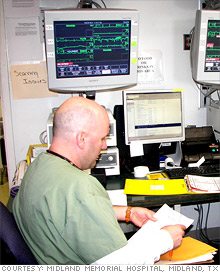 |
| A nurse at Midland Memorial Hospital in Midland, Texas uses the hospital's new electronic health record system. |
NEW YORK (CNNMoney.com) -- Getting an electronic health record system in place by 2014? Tough.
Getting hospitals to pay millions now for systems that comply with unknown standards and implement them by October 2010? Yikes!
That's President Obama's plan to get a centralized, digital medical record system up and running nationwide in five years.
It's an ambitious plan, but one the administration is passionate about.
"There are lots of moving parts, and we're working diligently on all of them," said Dr. David Blumenthal, the Department of Health's national coordinator for health information technology, or President Obama's so-called health IT czar, who is tasked with overseeing the electronic health record (EHR) project. "We believe EHR will become as integral to medicine as the stethoscope. Now, doctors are looking for a roadmap for EHR integration, and we're working to get help for them."
The plan. Spend a total of $20 billion of stimulus funds on hospitals and doctors offices that can prove by October 2010 that they use certified EHR "meaningfully." Those hospitals and physicians' offices that qualify become eligible for Medicare and Medicaid incentives through 2014, which experts say will average $7 million per year per hospital. Those that do not use electronic health records by 2015 will get their Medicare funding reduced.
The hurdles. Paying for expensive machinery, educating hundreds of physicians, ensuring patient privacy, networking between multiple platforms and complying to a yet-to-be-determined standard. (Not to mention a rapidly approaching qualifying deadline.)
Here's a a deeper look at what needs to get done:
Creating a standard. Experts say the biggest obstacle hospitals face in EHR implementation is the so-called meaningful use standard.
It may seem obvious, but qualifying physicians will have to prove they are putting certified digital health technology to good use, not just that they are in possession of the system. However, the government has yet to determine what that "meaningful use" entails. A period of public comment on the matter was just completed, and a ruling is expected by the end of the year.
Hospitals' EHR systems will also need to comply with certain government standards to be eligible for incentive payments. One such standard includes being able to network with other hospitals -- no easy task if hospitals use different software.
Meanwhile, many hospitals that were racing to implement an EHR system by the fall of next year have pulled back.
"Everyone's on pause right now, because everyone is waiting to see how money is going to flow, what the rules are and what meaningful use is," said Dr. David Brailer, chairman of Health Evolution Partners and former health IT czar under President Bush. "A lot of vendors have reported that customers have stopped looking at electronic health records."
As a result, Brailer believes that the meaningful use standard will be loose, even if a broader definition defeats much of the purpose of the standard.
"They'll go for the big tent as opposed to a narrow solution," said Brailer. "That's not good policy, but that's the politics of the matter."
Expensive technology. Implementing an EHR system from paper to hospital-wide integration costs anywhere from $50 million to $100 million, say experts. That includes not just the hardware and software, but also the service contract, networking with a national data center and lost productivity as hospitals teach physicians how to use the new system.
That's difficult for hospitals in the midst of a credit crunch and economic downturn, and especially onerous for small doctors' offices with just a handful of staff and patients. But there are other options.
One such alternative is the government's open-source EHR system, called Vista, which is already used by the Department of Veterans Affairs.
A commercialized version of the Vista software was developed by health care tech firm Medsphere, which said installation and service costs of the system average less than $1 million a year over the first five years, after which point annual service costs range between $150,000 to $700,000, depending on the size of the hospital.
"We have contracts with the entire public health system of West Virginia, in which eight hospitals will pay us a total of $9 million over five years," said Medsphere Chief Executive Mike Doyle. "Compare that to the University of West Virginia, which just paid $90 million to a proprietary EHR vendor. If Obama is serious about this, he won't be able to do it $90 million at a time."
However, experts say Vista is not suited for every hospital, especially bigger operations that require more complex systems integration. To make it more affordable, some proprietary vendors like General Electric (GE, Fortune 500), are offering loans up front to help hospitals integrate the systems.
Cost saving. Analysts say an estimated $700 billion a year is wasted on unnecessary tests and mistakes that a computerized system could help avoid.
Still, hospitals had been reluctant to change due to the up front costs. But industry professionals say the stimulus plan incentives are motivational factors.
"Many barriers stood in the way of adoption, but the Recovery Act began to, in a significant way, find solutions to the financing hurdles," said Janet Marchibroda, chief health care officer at IBM and former CEO of eHealth Initiative. IBM (IBM, Fortune 500) is facilitating EHR networking and connectivity solutions for some of the nation's largest hospitals and biotech companies.
Brailer said that 75% of hospitals reported in 2008 that they were either looking to implement EHR, were in the buying process or had already implemented a digital health record system. He also said that the government's firm stance behind EHR integration is signaling to hospitals that "the game's over."
Brailer's successor agrees.
"The Recovery Act has pushed the opinion about EHR forward from a somewhat resistant stance to recognition that this is going to happen," said Blumenthal. 



