
Microsoft and Yahoo: Search partners
After a year and a half of dealing, the tech giants reach a 10-year deal to take on Google, which holds a 65% market share in online search.



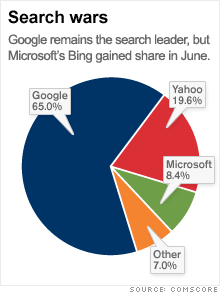
NEW YORK (CNNMoney.com) -- Microsoft and Yahoo reached a long-awaited partnership Wednesday in a bid to challenge Google's dominance in online search.
Under the 10-year deal, Yahoo.com and Bing.com will maintain their own branding but search results on Yahoo.com will say "powered by Bing." Yahoo, in turn, will be responsible for attracting premium advertisers.
Microsoft will pay Yahoo 88% of the revenue it gains from searches on Yahoo's sites. Microsoft will also have the rights to integrate Yahoo's search technology into its own existing Web search platforms.
Yahoo said the agreement will modestly decrease its overall revenue but increase its operating income by about $500 million annually.
Shares of Yahoo (YHOO, Fortune 500) tanked 12% on the news, as investors expected Microsoft to pay the company up to $1 billion in cash up front for the deal, albeit with a more modest revenue-sharing figure. Microsoft's (MSFT, Fortune 500) shares rose about 1%, and search leader Google's (GOOG, Fortune 500) stock price fell 1%.
The deal is expected to close in early 2010. U.S. users will start to see the change three months later and users around the world will see the full effect within two years.
"This deal is really about scale," said Yahoo Chief Executive Carol Bartz on a conference call. "By combining the ... technology of both companies, we can create a real, viable alternative for advertisers."
Microsoft said the transition will cost the company "several hundreds of millions of dollars," but it will benefit in the long run from the ability to charge advertisers more for its service, because the deal will improve the relevance of search results. Microsoft said it also expects to benefit from Yahoo's expertise, acknowledging that its new partner has more ad sales experience.
"This really is a win-win agreement both for Microsoft and for Yahoo," said Microsoft chief Steve Ballmer. "Consumers will get better products, and it will help the industry as a whole to prosper through our shared vision and shared values."
Bartz said that some Yahoo employees will eventually move over to Microsoft and that some search personnel would be laid off. But she added that the transition will occur over time, so virtually nothing will change at least until the deal is inked next year.
Google. Both Microsoft and Yahoo -- but especially Microsoft's Ballmer -- used their joint statement and conference call to offer several digs at search market leader Google.
In a joint statement, the companies said that "advertisers no longer have to rely on one company that dominates more than 70% of all search."
Ballmer argued that the search advertising market, as it is currently constructed, unfairly favors Google because of its dominance. He said many advertisers choose to enter into exclusive deals with leader Google to avoid the laborious process of entering into negotiations with three different companies.
But the new partnership will simplify that process, and "advertisers will know now that is is clearly the second place to work," said Ballmer.
He said he fully anticipates Google will launch an antitrust complaint against the partnership. "We'll likely face issues from 'the' competitor who may not like the competition," said Ballmer. "But our argument is we'll provide more competition, not less."
Google disagreed, saying in an emailed statement that, "There has traditionally been a lot of competition online, and our experience is that competition brings about great things for users. We're interested to learn more about the deal."
Microsoft and Yahoo will head to Capitol Hill and Brussels next week to begin the American and European regulatory processes for the deal.
An 18-month odyssey. It was a partnership that was a long time in the making. Microsoft's search market share has been slipping for more than two years, and the company has struggled to make its online advertising unit profitable. Meanwhile, Yahoo, once the search market leader, dropped to a distant second place behind leader Google by 2007.
The dealings between the two companies began Feb. 1, 2008, when Microsoft made an unsolicited $44.6 billion cash and stock bid for Yahoo. A week later, Yahoo rejected the bid, saying the offer "massively undervalues" the company.
In June of last year, Microsoft said it was no longer interested in acquiring Yahoo outright, but would like to enter a deal for Yahoo's search advertisement business.
Bartz and Ballmer said those preliminary discussions involved more cash up front for Yahoo but a less revenue sharing. Bartz said Yahoo insisted on a higher revenue number so it could invest in its long-term projects like its core online media businesses.
Though many analysts speculated that Microsoft's immediate success with its Bing search engine, unveiled last month, was the final nail in the coffin, Bartz said there was no one thing that pushed the deal through.
"It was the understanding and trust that we could have a partnership, and that takes time," said Bartz. "Finally the comfort level was there, and the proverbial snowball went down the hill. Once we reached a point in which it was clear that a deal was advantageous to both companies, we moved forward."
Ballmer said, for Microsoft, the deal wasn't better than the original revenue-sharing proposal, "just different." 



