Less junk mail: Good for you, bad for economy
Junk mail, also known as direct mail, is on the wane, as advertisers pull back spending. And that reflects wider problems in our economy.



NEW YORK (CNNMoney.com) -- You know it at as junk mail, though the industry prefers to call it direct mail. But whatever the name, you're getting a lot less of it.
But before you start rejoicing, think about what this means for the economy. Less junk mail means fewer companies want to sell you their services -- whether that's personalized checks or rug cleaning -- which reflects wider problems in our economy.
"In one way, it's good that we're getting less [direct] mail," said Andrew Davidson, senior vice president with Mintel Comperemedia, a Chicago-based firm that tracks direct advertising. "On the other hand, it's a sign that these companies, such as the card issuers and banks, are being more cautious in light of the difficult economic environment."
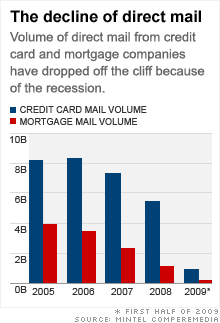
The credit card industry, among the most prolific of the direct-mailers, sent out 5.4 billion pieces of direct mail in 2008, down from 7.3 billion in 2007, according to Mintel. The decline became even steeper this year, with less than 900 million pieces mailed in the first six months.
The mortgage industry has also slowed down its direct mail offers of secured loans, from a peak of nearly 4 billion pieces in 2005, to about 1.1 billion pieces in 2008, according to Mintel. Only 220 million pieces have been mailed in the first six months of this year.
Kirk Swain, a partner with Directmail.com in Prince Frederick, Md., said that orders from charities and politicians have also dried up, since consumers no longer have the funds to make contributions.
"People, when they get scared, they tighten up their wallets," he said.
About the only industries still sending offers are insurers and telecommunications companies, said Davidson of Mintel. He said that "bundle" deals that include telephone, cable and Internet service remain popular, as are life and automobile insurance, which are some of the last things cash-strapped consumers will give up.
The overall decline of junk mail has pained the U.S. Postal Service, which is already billions of dollars in debt. Despite a $6 billion cost-cutting plan, the Postal Service lost $4.7 billion in the fiscal year-to-date for 2009, meaning the nine months ending on June 30. The Postal Service blames the reduction of mail volume, of which direct mail plays a major part. In fiscal year 2008, the most recent year for such data, 63% of all mail was direct advertising, according to the Postal Service.
"These are the worst trends that we've seen in direct mail, certainly for the last decade," said Bob Bernstock, president of shipping and mailing services for the Postal Service. "The marketing mail piece has gone from growth to decline. The economy is clearly the dominating factor."
Dr. Ramesh Lakshmi-Ratan, chief operating officer of the Direct Marketing Association, an industry trade group, expects direct mail to make a comeback over the next few years, once the economy as a whole recovers. "Do I see a good future for the Postal Service and direct mail?" he said. "Absolutely, but I think it's going to be different."
Going forward, he projects that the direct mail industry will have less emphasis on credit and more on savings-driven spending, as consumer habits shift towards cash over credit.
Sandra Blum, the Fairfield, Conn.-based author of "Designing Direct Mail that Sells," said that direct mail is more effective than e-mail marketing because consumers have learned to delete advertising e-mails without even reading them, undermining their effectiveness.
"I think that people are hedging their bets and turning to e-mail marketing, thinking that it's cheaper," said Blum. "But the key word is efficacy here. Believe or not, I think there's a greater feeling of privacy [with direct mail. If [consumers] can choose when to pay attention to it, they're tactile."
Another advantage of direct mail is that it doesn't cost the recipient anything, unlike faxes, pre-recorded ad calls and text ads.
"Junk mail, I don't have a problem with, honestly," said Brian Bromberg, a lawyer and member of the National Association of Consumer Advocates. "I don't find it particularly invasive."
And while he is "happy" about getting less junk mail in his mail box, he is "unhappy that it reflects the fact that the economy has tanked."