Doctors' orders: Avoid insurance
Many physicians, fed up with patient overload and filing claims, are minimizing insurance-based coverage and offering round-the-clock service for a retainer.



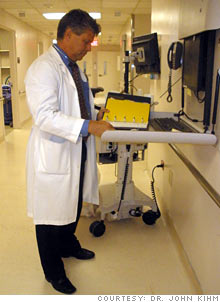 |
| Dr. John Kihm, who converted his practice to a retainer-based model this year, said he now see half as many patients and has doubled the time he spends per patient. |


NEW YORK (CNNMoney.com) -- Like a lot of their patients, doctors are sick of long waits in the waiting room and dealing with insurance companies.
That's why a growing number of primary care physicians are adopting a direct fee-for-service or "retainer-based" model of care that minimizes acceptance of insurance. Except for lab tests and other special services, your insurance plan is no good with them.
In a retainer practice, doctors charge patients an annual fee ranging from $1,500 to as high as over $10,000 for round-the-clock access to physicians, sometimes including house calls.
Other services included in the membership are annual physicals, preventive care programs and hospital visits.
Doctors argue that this model cuts down their patient load, allows them to spend more time per patient and help save the system money.
However, some industry groups caution that these emerging trends are a consequence of a health care system badly in need of reform.
"I had to change the model": Dr. John Kihm, 51, an internist based in Durham, N.C., converted his solo private practice to a retainer-based model in May.
Until then, his daily schedule was jam-packed. "I was seeing patients every 15 minutes," said Kihm.
He was seeing about 80 patients a week, "many were very sick with multiple systems and complications," he said. "After 20 years, I realized that this was not doable, not sustainable."
His goal is to continue medicine for another 20 years, "but I want to practice it the right way," Kihm said. That means spending more than 15 minutes per patients and doing house calls. "I had to change the model," he said, as he adopted the retainer-based structure.
He now spends 30 minutes on average per patient. He didn't disclose his annual fees but said his fees are "less that what it could cost to smoke a pack of cigarettes a day."
His fees covers annual exams, wellness programs and other types of preventative care typically not covered by insurance. If his patients do have insurance, it would pay for things like lab tests.
"My income is about the same as before, but I have less overhead costs from half as many patients and half the amount of supplies that I need," he said.
Michigan-based family doctor Dr. John Blanchard has been practicing the retainer-based care for eight years. He said his patients have "unfettered" access to him whenever they need him for a fee of between $50 to $150 a month.
The model has enabled Blanchard to "cut down on everything by about 25%," including his patient caseloads and time spent on filing insurance claims.
One industry report cited that processing claims is the second-biggest area of wasteful expenditure in the health care system, costing as much as $210 billion annually.
Prevention better than cure: MDVIP, based in Boca Raton, Fla., is one of the largest organizations of primary care physicians, numbering about 326 nationwide, that practice retainer-based medicine.
"We call it preventive, personalized health care," said Darin Engelhardt, president of MDVIP. "Our premise is if we reconstruct primary care, what would it look like?'"
According to the MDVIP formula, it means limiting its affiliated practices to no more than 600 patients.
For an annual fee of between $1,500 and $1,800, its members receive full health assessment, 24/7 access to their doctor, including via a doctor's cell phone or e-mail and a personal Web page on which they can access their medical records.
MDVIP-affiliated practices do take insurance, including Medicare, for other medical services such as lab tests and sick visits.
Engelhardt said MDVIP has about 110,000 members nationwide, half of whom are over the age of 65.
"This is a variation of the traditional model," he said. "We believe it enhances the physician-doctor relationship as well as reduces costs by stressing prevention."
Although official figures are hard to come by, Engelhardt said MDVIP's research based on Medicare data has shown that in communities with both MDVIP and traditional practices, hospitalization rates dropped by as much as 70% for its members.
He estimates that there are about 3,000 family physicians practicing a form of retainer-based medicine in the United States.
Concerns: The rise in alternative care delivery models indicates the level of frustration, both on the part of doctors seeing too many patients and consumers not getting easy access to doctors, said Dr. Lori Heim, president-elect of the American Academy of Family Physicians (AAFP).
"I am not judging this model. We don't have a policy against it," she said. "But I believe it reflects the underlying problems in the system. The retainer model won't solve all the problems in health care."
Heim said the model works better for physicians who practice in locations where consumers can afford it.
"It won't work in communities where I practice," Heim, of Laurinburg, N.C., said, referring to areas with a high number of uninsured consumers and a middle class that can't afford out-of-pocket membership fees.
At the same time, Heim warned that unless the current health care system changes, the retainer model could become more prevalent.
"If this is the model of care that we evolve into, then there could be fewer doctors for people at a time when we need more doctors," she said.
Alywn Cassil, spokeswoman for the policy research organization Center for Studying Health System Change, said retainer-based care is having a "marginal impact" on the industry so far.
"The vast majority of physicians still have a managed care contract," she said. "Only one in 10 don't."
But she agreed with Heim on one point: "If doctors further reduce their panel size of patients through these models, that will only enhance the shortage of primary care doctors," Cassil said.
What's more, the model creates a "tiered system" of access to care where even for the insured, if you pay more, you get enhanced access.
"You may be happier with it, but we have no idea whether this model makes you healthier," Cassil said.
"We don't hold ourselves as THE solution for everything that ails the health care system," MDVIP's Engelhardt said. "There is no one solution but there should be choice for consumers."