
Be afraid. Be sort of, sort of afraid.
Wall Street's so-called fear gauge, the VIX, has shot up this week. But with levels still well below last fall's peak, this is just a cause for mild concern, not panic.




NEW YORK (CNNMoney.com) -- What's that smell on Wall Street these days? Fear. Kind of.
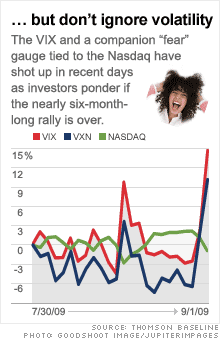
With stocks taking a tumble this week, it's not surprising that traders' favorite measure of fear -- the CBOE Volatility Index, or VIX -- is on the rise again.
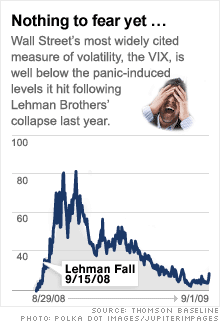
The VIX has soared nearly 20% during the past few days, and on Wednesday was hovering near 30, a level not crossed since early July. As a rule of thumb, when the VIX (VIX) is higher than 30, it's considered a sign that investors are getting worried.
So should you be concerned? Yes and no.
To put the sudden spike in context, the VIX is still way below the peak level of nearly 90 hit last October after Lehman Brothers collapsed.
In addition, the VIX is not necessarily a great tool for predicting market performance. It measures expectations of near-term volatility on a given day. To that end, the VIX was relatively flat last week -- before this week's turmoil. It has only shot up in the past two days while stocks were selling off.
This doesn't mean that people should completely disregard the VIX though. Fear, after all, does occasionally feed on itself. Just as stocks rallied throughout the summer, momentum could build on the downside and lead to a prolonged sell-off.
"The direction of the VIX is a concern because this is really a sentiment gauge. It could be a self-fulfilling prophecy since worries could prompt more worries," said Jack Ablin, chief investment strategist with Harris Private Bank in Chicago.
And considering that the S&P 500 is up more than 50% from its early March lows, it's only natural for investors to question if the rally is over -- or, at the very least, due for a pause.
What's more, September has historically been a down month for stocks, while October is the month that has become synonymous with market crashes. And in case you forgot (and you have a serious case of selective amnesia if you did), last September and October were kind of tumultuous.
"The recent VIX move is a symptom of worries about a typical seasonal correction. People are expecting the usual swoon in September and October and the memory of last September and October is still fresh in everybody's mind," said Nick Kalivas, vice president of financial research with MF Global, a futures and options brokerage in Chicago.
That said, investors have to resist the urge to panic. Some of the explanations that have been bandied about for this week's sell-off don't make much sense.
For example, Tuesday's nearly 200 point plunge was widely cited as a sell-off due to concerns of more bank failures. Most of the chatter was vague and not centered on any major bank.
But there were some mentions of the likely collapse of Chicago-based condominium lender Corus Bankshares (CORS) as helping to spark the sell-off. Concerns about specialty lender CIT Group (CIT, Fortune 500) deferring an interest payment also seemed to rattle investors.
Still, it's just silly to think that Corus and CIT are going to be the 2009 equivalent of Lehman and AIG (AIG, Fortune 500). Financial stocks -- both good and bad -- have surged since March even though 84 banks have already failed this year, including several that are larger than Corus.
It's highly unlikely that investors just woke up and realized that there are going to be many more FDIC Failure Fridays in 2009. Investors, and consumers for that matter, are now used to what happens when a bank is seized and sold off.
In addition, CIT has been flirting with trouble for the past few months and it's already been widely reported how close it came to bankruptcy.
And Corus has been a dead bank walking for some time. The stock, now trading at a mere 26 cents a share, has lost more than 90% of its value in the past year. And according to reports, the FDIC has set a deadline of Sept. 3 for bids on the bank.
Kalivas called the bank failure fears "a fabricated excuse" to explain Tuesday's market drop.
"People started to talk about troubles in the financial system and those rumors helped lift volatility. But it's hard to justify the jitters. There's nothing new of significance here," he said.
In fact, not much has changed in the past few days to all of a sudden cause a return of fear. The latest round of economic data suggests that the economy is improving, but not at a dramatic pace. And concerns about the job market are likely to linger as well.
So it's okay to be wary of the recent rally, but it's probably not a good idea to go all Chicken Little.
"An economic recovery is going be muted without employment picking up. But I don't think the increase in the VIX is a signal that conditions are any more perilous than they were a month ago," Ablin said.
Talkback: Are you fearful of what's next for the economy and stock market or do you think the recent sell-off just a short-term blip? Share your comments below. 



