

You can't handle the truth about stocks
Conventional financial planning has it all wrong, argues economist Zvi Bodie. If you need the high return of stocks to reach your goals, he says, then you can't afford to invest in them.



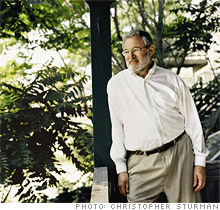
(Money Magazine) -- The advice rolls off the tongues of financial planners and appears frequently in the pages of financial magazines such as Money: To have any shot at retiring well, you need to invest a good portion of your money in stocks.
But mention this to Boston University School of Management professor Zvi Bodie, author of "Worry-Free Investing," and you'll get a stern reminder of how equities often betray investors. And you'll get an earful about how millions of us are taking too much risk with our nest eggs.
Bodie, who also co-authored a leading financial economics textbook with Nobel Prizewinner Robert Merton, has been trumpeting this message for decades. Writer Joe Light talked with Bodie about how he thinks savers have been deceived by the conventional advice, and how this decidedly unconventional thinker believes you should invest.
Were retirement investors taking on too much risk before the crash?
Yes. The standard models that are used to give investment advice to millions of Americans are fundamentally wrong. We're told that over time, stocks get less risky, but that's bull. Stocks are always risky -- whether in the short or long run. Prices dropped by 37% last year. While improbable, there's nothing to say they couldn't drop by that much again next year or the year before you retire. And diversification doesn't take away that risk. That's why retirement money belongs in truly safe assets whose value won't go down -- not in stocks.
That's easy to say now -- after the market crash. Have you always felt this way?
It's not Zvi Bodie the crackpot saying this. This is actually a standard way financial economists approach life-cycle investing. The starting point in economics is, "Suppose I don't want to take any risk? How would I allocate my income over my lifetime?" If you want to invest safely, you never invest in equities.
But don't you need the growth that stocks provide to combat the risk of inflation?
Inflation is exactly what Treasury Inflation-Protected Securities (TIPS) and I bonds were created to protect against. Even if equities did perform well in periods of inflation, you're exposing yourself to an even greater risk of a stock market decline. And as it turns out, anytime there's been significant inflation, equities have been a terrible investment. Just look at the 1970s.
So you'd tell an investor to have 100% of his retirement money in TIPS?
Yes. In fact, I have 100% of my own retirement money in TIPS. I do have a small account of nonretirement funds in which I invest in bonds, options, and stocks.
Currently, long-term TIPS earn just 2% after inflation. How is anyone going to be able to retire on so little growth?
If you look at most online retirement calculators, they make two assumptions: one, that you want to retire at age 65, and two, that people will be able to save only a certain amount -- say 10%. As a result, they spit out risky portfolios to get a higher return. Well, who says we all want to retire at 65 and can save only 10%? What if I retire at 70 or 75? What if I save 30%? Suddenly, you don't need to take so much risk in your portfolio. Now, if you put 100% in TIPS, you will have to save upwards of 20% of your annual pay, even if you're young, to retire at age 65. But I think it would be more reasonable to expect to retire at a later date.
Don't you think some investors would willingly choose to take on more risk in hopes of funding a better retirement?
Absolutely! But notice what they're being told. They're being told that by investing in equities, they are going to get a higher return without extra risk. That's the problem. You have to make a sacrifice somewhere -- whether that means accepting a lower standard of living now, picking a later retirement date, or taking on risk in your portfolio.
Can a worker earning, say, $60,000 a year and living in New York City save 20% to 30%?
You're able to save no matter what income you make, as long as it's above the subsistence level. You're just not going to have a very good standard of living. If I were in that situation, I just wouldn't plan on retiring. I'd work as long as I could.
Is it realistic to assume that even if you wanted to work until 80, that you could? What if you run into health problems or get laid off?
You're right. We live in a world of great uncertainty. There are certain kinds of risks we can eliminate, and certain kinds we can't. You can buy insurance against disability, or invest in yourself -- such as by taking classes to build your skill set. But sometimes there are risks we just have to live with. And you can't solve that by investing in equities.
So should no one invest in stocks -- not even the very wealthy?
You should only invest in equities what you can afford to lose. If you've already got a guaranteed level of income beyond what you would need to maintain your current standard of living, I guess you could take on risk with the extra money.
What if the market keeps moving up as it has over the past few months?
If the market goes up, people will say, "You see, look where you would have been had you listened to that jerk Bodie!" So in two years I could look bad -- but investors could also end up losing more than they can afford to lose.
Thinking of relocating to get a better job? Tell us your story. Please send an email with a brief description of your situation and a photo to Donna Rosato at donna_rosato@moneymail.com. For the CNNMoney.com Comment Policy, click here. 



