

Reaganomics is dead (long live Reaganomics)
Old-school supply-sider Bruce Bartlett says America needs a tax hike - and that Republicans should fight to make sure that it's done right.



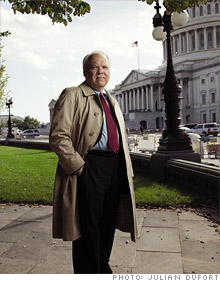
(Money Magazine) -- Bruce Bartlett was a lieutenant in the Reagan revolution. As an aide to congressman Jack Kemp, he helped write the legislation underpinning Ronald Reagan's 1981 tax cut and then worked in the Reagan and the George H.W. Bush administrations.
Bartlett still thinks low marginal tax rates fired up the '80s economy, but he laments that conservatives misunderstand Reagan's legacy, thinking of tax cuts as a cure for every ill.
His book criticizing George W. Bush got him fired from a conservative think tank in 2005. His latest, "The New American Economy," should stir up more controversy. For a start, he argues that conservatives can learn from John Maynard Keynes, the economist who argued for big government spending in times of crisis.
You were a Reagan-era tax cutter, but now you've written a book praising Keynesian economics, more spending, even tax hikes. What gives?
I wanted to show that economic ideas go through cycles. A crisis happens that the dominant thinking can't deal with, and a new theory comes along to solve the problem. When the crisis is past, that theory becomes the new all-purpose way to deal with every problem. And that leads to the next crisis.
Before John Maynard Keynes, economists had no solution to the Great Depression. They thought the government should do nothing. But after wartime spending pulled the economy out of the Depression for good, Keynes became the new conventional wisdom.
But Keynes's ideas were designed for a deflationary depression. When you apply that medicine in an inflationary situation, you get even more inflation. Keynesianism met its Waterloo in the stagflation of the 1970s.
Enter "supply-side" economics.
Almost. First the monetarists stepped in, arguing that to whip inflation we had to tighten the money supply. Supply-siders argued that we needed big tax cuts to give people incentives to work harder and get growth going. Tight money, tax cuts, and deregulation -- that was the model. Once Reagan did all that, cutting the top tax rate as low as 28% in 1986, there was nothing left to do. But armies don't disband at the end of wars. They find new ways to fight.
So are Republicans fighting the last war?
What good are tax cuts when people have no income to tax? In this crisis we've run into the same problem we had in the Great Depression: a liquidity trap. Money isn't circulating. The stimulus package may have been over-sold by Obama, but the principle was correct. We need government spending to get out of the trap.
Do you support the idea of another stimulus package?
No. The lags in implementation are so great that it would have no effect until long after the recovery is under way. And I think the makings of a fairly rapid recovery are here.
Nice to hear some optimism.
My Republican friends, to a person, think that Obama's policies are going to be disastrous and that they'll be able to waltz into the White House in 2012. I keep asking, "What if you're wrong? What's your backup plan in case the economy does recover and Obama gets credit for bringing us out of the biggest crisis since the Depression?"
What should we be worried about?
It's inevitable that we're going to have substantial inflation down the road. You know Congress and the White House will pressure the Fed to delay acting when the time comes. The longer-term problem is the aging of society and uncontrolled entitlements. When everyone realizes we have to tighten spending, it will be impossible to do because there will be so many old people, and they vote.
That leaves us one alternative: raising taxes. Conservatives view all tax increases as equally bad -- they'd rather default on the debt than raise taxes. But there are better and worse ways of raising taxes.
What's the better way?
A value-added tax. [A VAT is similar to a sales tax but easier to enforce, because it's paid every time a business makes a sale, not just on retail sales to consumers.] It's a consumption tax that has very little negative effect on incentives to work and save, meaning that you can raise a lot of revenue at relatively low economic cost. But conservatives think if we make it too easy for the government to raise revenue, then they'll raise too much, and the next thing you know we'll be like Europe.
As Larry Summers [Obama's chief economic adviser] once put it, we don't have a VAT because liberals think it's regressive and conservatives think it's a money machine. We'll get a VAT when liberals figure out it's a money machine and conservatives figure out it's regressive.
Obama is more likely to want to tax the incomes of the rich.
The mistake of the left is to assume you can raise rates on the rich and they won't react. They'll put more effort into tax avoidance and evasion. That won't do anyone any good except tax lawyers. But not raising taxes at some point isn't an option. If Republicans refuse to put anything on the table, Democrats will raise taxes in a way that suits them. 



