Bailout's hidden costs
SigTARP Neil Barofsky, overseer of the $700 billion TARP program, says the cost to taxpayers will be a lot greater than the government is letting on.



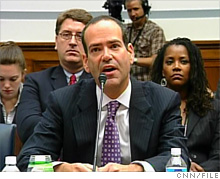 |
| A new report from Special Inspector General Neil Barofsky says the $700 billion bailout will cost more than many think. |
NEW YORK (CNNMoney.com) -- The $700 billion bailout will ultimately cost taxpayers billions of dollars, but the government stands to lose much more than the money it's pouring into companies.
Neil Barofsky, special inspector general for Treasury's financial sector rescue, wrote in a report released Wednesday that the bailout has several hidden costs.
One is the hard cost of borrowing money to fund the rescues of banks and other companies. The others are, according to Barofsky, less tangible but no less important: The danger that comes with rewarding companies that took excessive risk, and the loss of the government's credibility with taxpayers.
"You can't just think of this program in terms of dollars and cents," Barofsky told CNNMoney. "We try to bring attention to these other costs, which have the potential to dwarf the monetary loss in dollars."
To be sure, the monetary loss will likely be substantial: Barofsky cites the Congressional Budget Office estimates that the Troubled Asset Relief Program will ultimately cost taxpayers $159 billion.
But Barofsky focuses his report, a quarterly update to Congress and the public, on what he identifies as the unseen costs and risks of TARP.
To fund the $467.1 billion that Treasury has spent so far on the bailout, the government has borrowed money by issuing debt in the form of Treasury bonds.
It's unclear exactly how much the government had to borrow to pay for TARP. But according to Barofsky's report, the government paid for 46% of its expenditures in 2009 by issuing new debt, compared with the 10-year average of 9%.
Barofsky said that's okay for now, since the cost of funding through debt is very cheap because of historically low interest rates. But as the government's debt mounts through bailouts and stimulus, rates could go higher and the government's interest payments could get much more expensive.
"Taking on new debt is an action that has implications for the true cost of the U.S. government's financial rescue initiatives," said Barofsky in the report. "This cost may have significant refinancing risk."
Another hidden cost could come in the form of promoting bad behavior.
After financial institutions threatened the stability of the economy by making irresponsible bets, the government responded by sending them massive infusions of capital. In addition, Treasury gave companies cheap loans to encourage them to buy risky assets like mortgage-backed securities that were a major cause of the credit crisis. The report also notes that "too big to fail" firms only got bigger because of TARP.
All of these issues have set the stage for another large-scale bust unless serious effort is made on reforming regulation of the financial markets, the report said.
"With the potential of moral hazard and 'too big to fail,' the government could be setting itself up for an even more dangerous crisis in the future," Barofsky told CNNMoney. "The ways of addressing these issues are through meaningful regulatory reform."
Barofsky, in the interview, wouldn't comment on which of the administration's regulatory reform plans he favors, but he said action needs to happen soon. In his report, he argued that the recent stock market rally has removed some of the urgency of dealing with the financial system's fundamental problems, but the cost of inaction could be even higher than the current bailout.
Barofsky also said that the government's lack of transparency about the bailout could cost taxpayers in the long run, as a growing distrust of the government could impede its ability to enact important legislation.
"I think we are already seeing the political costs of people losing trust and faith in their government, such as the palpable anger this summer in response to health care," Barofsky told CNNMoney. "It requires a certain amount of good will to support extremely important and expensive programs like bailouts."
Barofsky said Treasury's assurances to the public last year that it would only invest in healthy companies was undermined by the need to give additional, emergency bailouts to Citigroup (C, Fortune 500) and Bank of America (BAC, Fortune 500). He also argued that Treasury's refusal to require TARP recipients to report on their use of taxpayer funds have both damaged the government's credibility and also the effectiveness of the bailout.
As a result, the report said that anger and cynicism about the bailout could be one of TARP's most "substantial, albeit unnecessary, costs."
"The loss of confidence in the government could be one of the lasting legacies of this program," said Barofsky. "But if Treasury would adopt some pretty basic recommendations, it would at least address some of these suspicions."