
No relief in sight for Main Street banks
With loan losses still mounting, some regional banks aren't looking to return to profitability until 2011.



 |
| Many regional lenders lost money in the third quarter after aggressively boosting their reserves for future loan losses. |
NEW YORK (CNNMoney.com) -- JPMorgan Chase, Goldman Sachs and other Wall Street megabanks may be showing signs of recovery lately, but things are hardly looking up for regional banks.
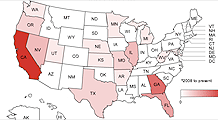
From the Rust Belt to the Deep South, big commercial lenders with more routine banking businesses have endured some of their worst losses since the financial crisis began more than a year ago.
Last week, Regions Financial (RF, Fortune 500) and Sun Trust (STI, Fortune 500), two of the biggest regional banks in the Southeast, each reported losses of nearly $400 million in the latest quarter.
Milwaukee-based lender Marshall & Ilsley (MI) and Utah's Zions Bancorp (ZION) each suffered their fourth consecutive quarterly loss. They both set aside mountains of cash for future loan losses as well.
Just a year ago, such tales were the exception rather than the norm as regional banks remained largely immune to the troubles on Wall Street.
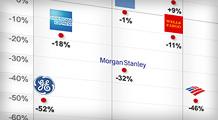
Instead, it was the more well-known securities firms and large diversified banks that were hemorrhaging money, such as Citigroup (C, Fortune 500) and Bank of America (BAC, Fortune 500), as they were forced to write down the value of complex securities tied to the U.S. housing market.
However, the tables have turned lately. JPMorgan Chase (JPM, Fortune 500) has profited handsomely from a recovery in the bond market and renewed merger activity. Some analysts even believe the worst is behind Citi and BofA.
But regional banks, which rely on the simple business of taking in money and lending it back out at a higher rate, are finding themselves squeezed by losses in their consumer and business loan portfolios.
Ongoing troubles in the U.S. housing market and rising unemployment levels have created additional headaches for their residential mortgage and home equity portfolios.
At the same time, many regional lenders have been bracing for a potential tidal wave of problems in one of the biggest parts of their business: commercial real estate loans.
"Loans in those categories are still under a lot of pressure," said Fred Cannon, chief equity strategist for Keefe, Bruyette & Woods, a firm that focuses on financial services companies.
Hoping to sidestep some of those problems, many lenders have moved aggressively to clean up their books.
Georgia's Synovus Financial (SNV), for example, revealed last week that it sold $339 million worth of its troubled assets -- mostly mortgages and real-estate development loans -- in the latest quarter.
Other banks have aggressively bolstered their loan loss reserves to brace for the looming commercial loan fallout, even if it means suffering a loss. Among those was Marshall & Ilsley, whose provisions for loan losses more than tripled from the previous quarter to $578.7 million.
Marty Mosby, a bank analyst at FTN Equity Capital Markets, said that as painful as those steps have been, regional bank executives think that by taking them, they can position their firm to recover once the U.S. economy does.
"They don't want to be the last bank to come out of this [recession]," said Mosby. "They want to prepare for it as soon as possible."
Of course, the recession hasn't been devastating for all regional lenders.
Commerce Bancshares (CBSH), which boasts over 370 locations across Missouri, Illinois and Kansas, reaped the benefits of years of conservative underwriting and higher profit margins on loans this quarter. The bank reported earnings that doubled from a year ago.
And two banks based in California, City National (CYN) and Westamerica Bancorp (WABC), have remained consistently profitable despite their exposure to the economically hard-hit state.
What troubles some analysts, however, is that even the most well-run lenders may have a hard time forecasting the scope of future losses, especially within their commercial real estate portfolios.
It is no surprise then that analysts don't expect regional banks, as a group, to return to sustained profitability anytime soon.
The 11 regional banks in the S&P 500, for example, are expected to cumulatively lose $10.4 billion this year and $140 million in 2010, according to Thomson Reuters.
"Regional banks are still under a lot of pressure," said Cannon. "[Their] losses may be extended for some time." 



