
Obama signs jobless benefit extension
Bill extends unemployment benefits by up to 20 weeks. Legislation also extends homebuyer tax credit into next year.



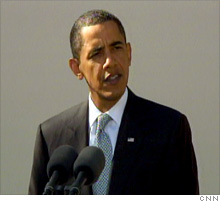 |
| President Obama said he signed a bill to provide up to 20 weeks of jobless benefits to unemployed Americans to "help create and save jobs." |


NEW YORK (CNNMoney.com) -- President Obama said he signed into law Friday a bill to provide up to 20 additional weeks of jobless benefits to unemployed Americans and extend the $8,000 tax credit for new homebuyers into the middle of next year.
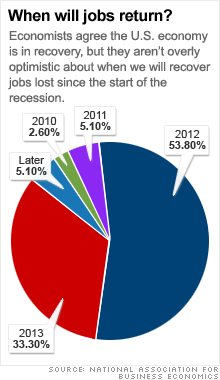
The signing came after the Labor Department reported that the unemployment rate spiked to a 26-year high of 10.2% in October, with 190,000 jobs lost in the month.
After calling the jobless rate "sobering," Obama said the bill he signed will "will help grow our economy, help create and save jobs, and help provide necessary relief to small businesses," in a statement following the signing.
The House approved the measures by a 403-12 vote Thursday afternoon, a day after the Senate passed the legislation.
The closely watched legislation will extend jobless benefits in all states by 14 weeks. Those that live in states with unemployment greater than 8.5% will receive an additional six weeks. The proposal will be funded by extending a longstanding federal unemployment tax on employers through June 30, 2011.
The measure will apply to those whose benefits run out by Dec. 31, which is nearly two million people, according to Senate estimates. Those whose checks have already stopped will be able to reapply for another round.
The House, which passed its own benefits extension in September, giving an additional 13 weeks in high-unemployment states, approved the Senate's version.
"The bill will mark another step toward a boost in our economic growth and it will make critical investments for our families and our workers," said Speaker Nancy Pelosi, D-Calif. "The legislation offers a lifeline to out-of-work Americans, to the men and women hardest hit by the recession."
"The bill also a places a down payment on the future of our middle-class because it extends, for the first-time homebuyer, a tax credit helping more Americans purchase homes and making it a little easier for families to move into a new house and keep a roof over their heads," she added.
The Senate had been bickering over the details since September, and that cost more than 200,000 people their benefits. Some 7,000 unemployed Americans run out of benefits each day, according to the National Employment Law Project.
Millions of Americans are now depending on unemployment benefits, as the unemployment rate continues to soar.
More than one in three people who are unemployed have been out of work for at least six months, according to the law project.
Lawmakers twice lengthened the time people can receive checks to as much as 79 weeks, depending on the state.
The legislation also will extend the $8,000 homebuyer tax credit to contracts signed by April 30 and closed by June 30. The controversial credit, which many say has boosted home sales in recent months, was set to expire after Nov. 30.
The bill also creates a $6,500 credit for those who buy a home after living in their current house at least five years. That measure will apply to contracts signed by April 30 and closed by June 30. The current credit defines a first-time homebuyer as someone who has not owned a residence within the past three years.
The credit will be available only for the purchase of principal residences priced at $800,000 or less.
The bill will raise the adjusted gross income cap to $125,000 for single filers and $225,000 for joint filers. The amount of the credit currently begins to phase out for taxpayers whose adjusted gross income is more than $75,000, or $150,000 for joint filers.
"It's gonna put people back to work, the home builders, put people in the real estate business," said Sen. Chris Dodd, D-Conn. "The kind of jobs that can make a difference."
The extension will cost $10.8 billion over 10 years, according to the Joint Committee on Taxation.
Through mid-September, 1.4 million tax returns had qualified for the credit, according to the IRS. Some portion of those returns, which the IRS couldn't specify, represents buyers who took advantage of an earlier version of the tax credit, which was only worth $7,500 and has to be repaid over time.
By the end of November, the credit will have been used by 1.8 million homebuyers, at least 355,000 of whom would not have bought a house without the tax break, according to estimates by the National Association of Realtors.
"The data on the present home buyer tax credit show that the credit has had its intended impact -- sales have jumped in recent months to a projected 5.1 million for the year and housing inventory has been trimmed, thus stabilizing home prices noticeably," said Ron Phipps, the association's first vice president, in Senate testimony last month.
The credit, however, has also posed many problems. Critics say it's a waste of money because most of those claiming the credit would have bought homes anyway.
It's also been the target of fraud. Some 74,000 people claimed more than $500 million in credits even though they may not be first-time homeowners, according to Treasury officials. And more than 580 children, including some as young as 4-years-old, have claimed the credit.
"Some key controls were missing to prevent an individual from erroneously or fraudulently claiming the credit and receiving an erroneous refund of up to $8,000," said J. Russell George, Treasury inspector general for tax administration, before a House subcommittee last month.
(See how the legislation also offers a big tax break for business.)
CNN Radio Capitol Hill correspondent Lisa Desjardins and CNNMoney.com staff reporter Hibah Yousuf contributed to this report. 



