(CNNMoney.com) -- Richard Brauman always loved caviar. But for many years the former Federal Reserve employee found that, no matter how much he was willing to pay for quality, the goods often had a stale, fishy taste. He blamed it on the traditional practices of companies in caviar-producing countries like Russia and Iran, where fish eggs are harvested infrequently and may be heavily preserved with salt and borax.
Brauman, 34, thought he could do better. So in 2005 he launched The Little Pearl in Somerville, Mass., to source caviar from farms and fisheries where fish are handled humanely, harvested year-round and fed a combination of their natural diet and commercially produced food pellets. In 2007, Bon Appetit conferred its Best American Caviar award on salmon eggs from The Little Pearl.
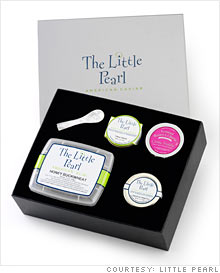 |
| All of Little Pearl's caviar is domestically harvested and processed in the U.S. |
Today the 10-employee company has a distribution deal with Whole Foods and offers 13 varieties of American caviar. Prices range from $11.99 for two ounces of whitefish caviar sold in New England to $99.99 for one ounce of "T Rex" -- white sturgeon caviar from Idaho -- sold in Texas. In 2009, The Little Pearl brought in revenue of $410,000.
Now Brauman is setting his sights on a new shore: revolutionizing how fish is grown.
Farmed fish comprises half of all fish consumed globally, but it has many flaws. Tainted fish food introduces mercury and PCBs, and tightly packed ocean pens breed diseases and parasites. So Brauman devised an aquaculture system that will raise fish at low density in tanks of clean water -- and also grow the food to feed them.
"That's pretty innovative," says Geoff Shester, a marine biologist and senior science manager of the Seafood Watch Program at Monterey Bay Aquarium. One of the biggest problems with farmed fish is their diet: primarily pellets containing dried sardines and anchovies, which are overfished to the point of disrupting the ocean's food chain. And it's massively inefficient. "It takes five pounds of wild fish to produce one pound of farmed fish," Shester says.
That's where Brauman's sustainable fillet comes in. The idea is to grow fish in a system of channels and circular tanks, where filters will remove ammonia and carbon dioxide -- fish waste products -- and push them into a warmer tank to feed algae, which contains fatty acids that are the precursors to the healthful fats found in fish. The algae gets flushed into a tank where it feeds plankton, which is later eaten by salmon and sturgeon or, alternately, removed and dried to make fish food pellets.
Brauman is currently seeking $250,000 in grant funding to build a small starter farm at university or oceanographic institute. Ultimately, he envisions a 100-acre farm that uses 20 million gallons of coastal water. Large companies that have invested in "multi-trophic aquaculture" are still behind Brauman, Shester says; they're only at the research and development phase.
Gavin Egbert, seafood coordinator for Whole Foods' North Atlantic region, says sales of Little Pearl caviar at stores in his area doubled over the past year. As for Brauman's expansion into the fillet business, Egbert says, "We'd be really excited about that."
The risks are enormous. The best-laid business plans have a hard time winning capital in the midst of a recession. For Brauman, who hasn't finished his prototype farm yet, it's proved nearly impossible. Plus, science and finance don't always jibe. Brauman says it's challenging to attract venture capitalists, who typically want a promise of precisely plotted, concrete results within a few years. Fish farming, like all farming, has an element of unpredictability.
"They want to know when we will have fillets to sell, and we can give them a range like three to five years, but nothing exact," Brauman says. "Let's say we had a really bad storm and the roof above the fish farm collapsed. The fish could die, and that would set us back."
But the benefits -- both environmental and financial -- could be quite a catch. In the first year on a full-production farm, Brauman believes, revenues could hit $30 million. 



 How does a florist sell more in this economy? We changed our business to designing weddings and events only, as the everyday flowers are not selling. We had to throw out too much product at the end of the week -- flowers are perishable! More

| Overnight Avg Rate | Latest | Change | Last Week |
|---|---|---|---|
| 30 yr fixed | 3.80% | 3.88% | |
| 15 yr fixed | 3.20% | 3.23% | |
| 5/1 ARM | 3.84% | 3.88% | |
| 30 yr refi | 3.82% | 3.93% | |
| 15 yr refi | 3.20% | 3.23% |
Today's featured rates:



|
Bankrupt toy retailer tells bankruptcy court it is looking at possibly reviving the Toys 'R' Us and Babies 'R' Us brands. More |
Land O'Lakes CEO Beth Ford charts her career path, from her first job to becoming the first openly gay CEO at a Fortune 500 company in an interview with CNN's Boss Files. More |
Honda and General Motors are creating a new generation of fully autonomous vehicles. More |
In 1998, Ntsiki Biyela won a scholarship to study wine making. Now she's about to launch her own brand. More |
Whether you hedge inflation or look for a return that outpaces inflation, here's how to prepare. More |



