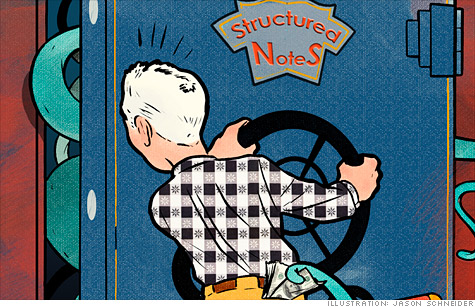
FORTUNE -- Given the wrenching market volatility in recent weeks, the idea of shielding your portfolio from a big decline while still being able to profit from future gains sounds mighty appealing. That's the promise of the so-called structured note, a product that's been popular with institutional investors for years. Now Wall Street is aggressively marketing these notes to individual investors. And retail sales of structured notes are booming: They increased by 46% in 2010 to a record $49.4 billion, according to Bloomberg, and are on track to be up again sharply in 2011.
But beware: The retail versions are watered-down, overpriced imitations of the protection offered to the big guys -- and may be riskier than advertised. Indeed, in June both the Financial Industry Regulatory Authority (FINRA) and the Securities and Exchange Commission issued alerts warning about their significant drawbacks.
Structured notes are customized investments that typically package together a zero-coupon bond with derivatives. The idea is to give investors upside exposure to a specific asset class -- stocks, commodities, or currencies, for instance -- while simultaneously providing the relative safety of a bond held to maturity. But there are a lot of potential problems hidden in the fine print.
Start with the way returns are calculated. In exchange for limiting your losses, most structured notes also cap your upside. But it can be drastically less than the market's actual gains. In one example cited by the FINRA alert, an investor will receive the market's full gain if an underlying index rises up to 40% over the life of the note. But if the index rises 41% or more, the investor's return is automatically slashed to 10%. Many structured notes are also callable, meaning the issuer can force investors to redeem them before the return gets too high. Gains can also get dinged by higher-than-usual taxes. Notes that fully protect your principal are generally taxed at ordinary income rates -- which can top 30% -- instead of the more favorable long-term capital gains rate of 15%.
The downside protection can also be lacking. For instance, many notes will shield your principal from mild stock losses -- say, up to 10%. But if the market falls by more than that, the value of your note could tank right along with it. You'll also forfeit the principal protection if you don't hold the note to maturity. If you have to sell before then, you'll probably lose money, since there's not much of a secondary market for the notes. And if the issuer goes bankrupt, you'll be treated as an unsecured creditor and recover little, if anything, of your original investment.
You're also going to pay a hefty fee, often at least 3% of your investment. "I've never seen a cheap retail structured note," says Kent Smetters, a professor of risk management at the University of Pennsylvania's Wharton School. Perhaps someday Wall Street will offer individual investors a structured note that's as appealing as what they offer to their institutional customers. Until then, take a pass.
--A former compensation consultant, Janice Revell has been writing about personal finance since 2000.
This article is from the September 5, 2011 issue of Fortune. 

Carlos Rodriguez is trying to rid himself of $15,000 in credit card debt, while paying his mortgage and saving for his son's college education.

Susan Carson and Laura DeLallo make $225,000 and have half a million in retirement savings, but their sprawling portfolios is proving hard to manage.
| Overnight Avg Rate | Latest | Change | Last Week |
|---|---|---|---|
| 30 yr fixed | 3.80% | 3.88% | |
| 15 yr fixed | 3.20% | 3.23% | |
| 5/1 ARM | 3.84% | 3.88% | |
| 30 yr refi | 3.82% | 3.93% | |
| 15 yr refi | 3.20% | 3.23% |
Today's featured rates: