NEW YORK (CNNMoney) -- The 122-year reign of the celluloid 35-millimeter film projector is about to come to an end.
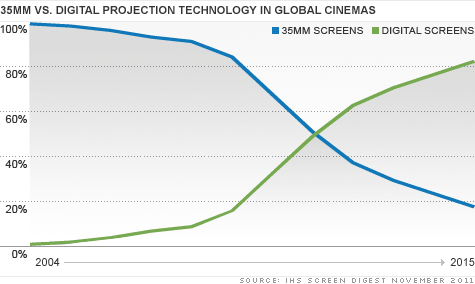
In just two months, digital will overtake film as the predominant movie projector technology in the world's cinemas, according to a study released this week by IHS. It will be the first time since the advent of the motion picture in 1889 that film projectors will be used to screen a minority of movies.
The most amazing thing about the transition is not how long film stuck around, but just how dramatic and rapid the shift to digital projectors was. Film projectors were in more than 99% of theaters as recently as 2004 and 85% in 2009. That number slid to 68% last year, and by the end of next year, film will be present in just 37% of cinemas.
In 2015, IHS says film will be relegated to "niche" status, used in just 17% of movie theaters worldwide.
How did the mighty fall so quickly? In a word: Avatar.
The blockbuster 3-D movie's release in late 2009 sparked a rapid increase in digital projector purchases, since its three-dimensional effects couldn't be viewed with a celluloid film projector. Not wanting to miss out on the highest-grossing movie of all time, theaters were quick to upgrade their technology.
"The release of Avatar represented the pivotal moment for digital cinema," said David Hancock, head of film and cinema research at IHS. "Before Avatar, digital represented only a small portion of the market. This single film has driven up demand for digital 3-D technology at the expense of traditional 35-mm celluloid."
Since then, movie theaters have been welcoming the rebirth of the 3-D movie, as they can often charge more money for the shows.
The transition has been especially noticeable in the United States, where IHS predicts there will be no more mainstream 35-mm film projector usage after 2013. Western Europe will reach that point by 2014, and as pressure builds from Hollywood studios that want to ship films in just one format, most of the rest of the world will likely be forced to say goodbye to film projectors the following year.
Though the majority of movies are still shown using film -- at least until January -- most Hollywood pictures have actually been shot using digital cameras for quite some time. Some traditionalists remain, of course. Star Trek director J.J. Abrams noted that he chose to shoot the movie using traditional film to capture a certain glare effect that digital cameras couldn't replicate.
Even though the film wasn't shot digitally, many people around the world still watched it on a digital projector. Soon, no matter how a Hollywood movie is captured, it will have to be digitized at some point.
That means demand for celluloid is rapidly declining. More than 13 billion feet of 35-mm film were sold globally in 2008, but that number is expected to sink to just 4 billion feet next year, IHS said.
What's even more worrisome for celluloid producers is that the cost of making it is soaring due to the rising price of silver, a key raw material in the production of film. IHS predicts the major celluloid manufacturers -- Kodak (EK, Fortune 500) and Fuji -- could be consolidated down to just one by 2015.
Of course, film will never completely go away. Art-house cinemas, particularly the roughly 3,000 publicly funded ones in Western Europe, will help keep film alive. Older films that were never digitally transferred will live on there.
But they'll be relics. IHS expects those last prints to soar in value as the rest of the world moves to digital.