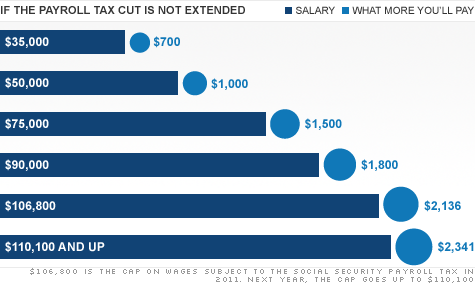
If Congress lets a temporary payroll tax cut expire on Dec. 31, workers next year will pay another 2 percentage points of their income on the first $110,100 in wages.
NEW YORK (CNNMoney) -- House Republicans on Tuesday rejected the the two-month payroll tax extension passed by the Senate. But they did so indirectly.
Rather than bring the bill to the floor for a direct vote -- and risking the measure actually passing -- they voted to instruct House negotiators to push for a year-long extension in a conference with the Senate.
The problem is that Senate Majority Leader Harry Reid has said there would be no further negotiations until the House passes the temporary two-month extension to insure the tax cut doesn't lapse after Dec. 31.
Welcome to the latest, completely willful congressional standoff.
While Democrats and Republicans in both chambers would prefer a one-year extension, the parties in the Senate were unable to reach agreement last week over how to pay for the measure. And the offsets passed by House Republicans earlier didn't pass muster with Senate Democrats.
So, in 11 days, unless lawmakers figure a bipartisan way out, the payroll tax cut that has saved a typical household $1,000 this year will expire. (Read:Business tax breaks at work)
Failure by Congress to extend the cut would affect everyone's wallet and could hurt the economy.
The impact on your wallet: Thanks to the payroll tax cut, employees only had to pay 4.2% of their first $106,800 in wages into Social Security this year, instead of the normal 6.2%.
If the cut expires, workers in 2012 will pay the extra 2 percentage points of their income up to the wage cap, which next year will be $110,100.
That means low-income workers will pay several hundred dollars more than they're paying now, while high-income workers will pay roughly $2,340 more.
If the cut is extended as is, workers would see no difference in their payroll tax liability next year.
The economy: The payroll tax cut for individuals was originally passed at the end of 2010 to help boost the flagging economy.
Given the disappointingly slow pace of recovery since then, however, many politicians and economists have pushed to keep the tax cut in place for another year.
"This is the medicine that we can use in the near term to help strengthen the recovery and to help to provide insurance against shocks that might be coming," said Alan Krueger, chairman of the president's Council of Economic Advisers, during a White House press briefing earlier this month.
Were the tax cut to expire, many economists say it could take a bite out of their already modest economic growth forecasts for next year and result in job loss. If lawmakers don't extend the cut and they let long-term federal unemployment benefits expire, too, that could reduce economic growth by 1% to 1.5%, they say.
But relative to other ways to spur the economy, some say a general payroll tax cut isn't the best way since it isn't narrowly targeted to low and middle-income households, which are most likely to spend the extra savings.
"[M]any relatively high-income workers -- who are more likely to save rather than spend some of this windfall -- would benefit. And if the idea is to boost the economy by increasing demand for goods and services, giving the money to savers isn't helpful," Urban Institute resident fellow Howard Gleckman wrote in TaxVox.
The Congressional Budget Office estimates payroll tax cuts would generate between 10 and 90 cents in economic activity for every dollar of budgetary cost.
The tax cut could help increase production and jobs, CBO Director Douglas Elmendorf told the Senate Budget Committee earlier this month. But, he added, "those effects would be spread over time [since] CBO expects that the majority of the temporary increase in take-home pay would be saved rather than spent." 
| Overnight Avg Rate | Latest | Change | Last Week |
|---|---|---|---|
| 30 yr fixed | 3.80% | 3.88% | |
| 15 yr fixed | 3.20% | 3.23% | |
| 5/1 ARM | 3.84% | 3.88% | |
| 30 yr refi | 3.82% | 3.93% | |
| 15 yr refi | 3.20% | 3.23% |
Today's featured rates:
| Latest Report | Next Update |
|---|---|
| Home prices | Aug 28 |
| Consumer confidence | Aug 28 |
| GDP | Aug 29 |
| Manufacturing (ISM) | Sept 4 |
| Jobs | Sept 7 |
| Inflation (CPI) | Sept 14 |
| Retail sales | Sept 14 |