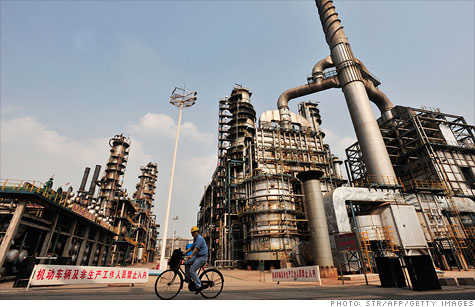
A worker rides a bicycle at a Sinopec oil refinery in China. State-owned enterprises, like Sinopec, account for roughly 40% of the country's GDP, according to estimates.
NEW YORK (CNNMoney) -- The World Bank and a Chinese think tank will have a stern warning in store for China's government on Monday: Transition to a freer commercial system, or else face an impending economic crisis.
As first reported by the Wall Street Journal, the "China 2030" report recommends China enact reforms promoting a freer econom. Those reforms include a major overhaul turning China's powerful state-owned companies into commercial enterprises.
The World Bank confirmed it will release the report Monday in Beijing.
The report is compiled by the World Bank and the Development Research Center, a research group that reports directly to China's State Council. According to the Wall Street Journal, it encourages China to also promote innovation, competition and entrepreneurship as a means of economic growth, rather than allowing growth to be primarily government engineered.
The world's second largest economy has been rising rapidly, averaging around 10% growth a year for the last three decades. Much of that momentum has come as China's rural population moves into the cities and as the government has funded massive infrastructure projects and retained a powerful influence over the country's biggest companies.
State-owned companies dominate China's banking, energy, telecom, health care and technology sectors. Overall, they account for about 40% of the country's gross domestic product, estimate Andrew Szamosszegi and Cole Kyle, who have researched the topic for the U.S.-China Economic and Security Review Commission.
Their latest report to the commission puts it bluntly: The Chinese government has not "expressed an interest in becoming a bastion of free market capitalism."
Critics point out that China cannot keep up its rapid growth under this system forever. Emerging economies tend to start slowing when their economy reaches about $16,740 per capita, according to research by economists Barry Eichengreen of the University of California at Berkeley, Donghyun Park of the Asian Development Bank and Kwanho Shin of Korea University.
They suspect China will hit that point around 2015.
One big unknown surrounding the World Bank's report is its suggestion that asset management firms manage the oversight of state-owned enterprises.
China has four major asset management companies that it originally created to oversee bad loans spun off from its four major banks. Currently, they're 100% owned by the Chinese government. Unless the report says those firms should become independent, it's unclear how moving state-owned enterprises under their purview would be a major improvement.
"It could be just like moving chess pieces around," said Cole Kyle. "We have to wait for the details." 
| Overnight Avg Rate | Latest | Change | Last Week |
|---|---|---|---|
| 30 yr fixed | 3.80% | 3.88% | |
| 15 yr fixed | 3.20% | 3.23% | |
| 5/1 ARM | 3.84% | 3.88% | |
| 30 yr refi | 3.82% | 3.93% | |
| 15 yr refi | 3.20% | 3.23% |
Today's featured rates:
| Latest Report | Next Update |
|---|---|
| Home prices | Aug 28 |
| Consumer confidence | Aug 28 |
| GDP | Aug 29 |
| Manufacturing (ISM) | Sept 4 |
| Jobs | Sept 7 |
| Inflation (CPI) | Sept 14 |
| Retail sales | Sept 14 |