|
This PC wants to save the world Nicholas Negroponte's much-hyped $100 laptop is going into production, but skeptics, including Intel, see weaknesses in his plan.  (Fortune Magazine) -- "Nicholas, it looks like a science project," Apple (Charts) CEO Steve Jobs said to Nicholas Negroponte, the Pied Piper of the $100 laptop, as he demonstrated one of its first versions. Skeptics abounded when, in early 2005, Negroponte left MIT's Media Lab, which he founded and ran for 20 years, aiming to build a supercheap portable computer for the world's poor children. His first designs were lackluster, as Jobs pointed out. For months Negroponte toted around a mockup whose screen folded out like a tent so a tiny lamp could project an image.
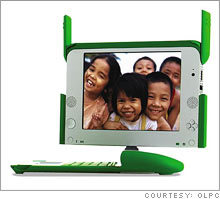
But today Negroponte's One Laptop Per Child (OLPC) initiative is preparing to launch its dream machine. In early November, 5,000 test units are slated to start rolling off state-of-the-art production lines owned by OLPC partner Quanta Computer (Charts) of Taiwan, the world's largest maker of laptops. Muammar Qaddafi plans to give one to every schoolchild in Libya. Shimon Peres hopes to do something similar for Palestinian kids in the West Bank. Negroponte has also seduced the leaders of Argentina, Brazil, Nigeria and - until the recent coup - Thailand with his vision. Each says he wants at least a million for his country's children. And serious talks are underway with Ethiopia, Indonesia, Mexico, Vietnam and others. Now called XO, the device has evolved into something both practical and sleek. Gone is the second prototype's hand-cranked generator, meant to free students from the need for an electric plug. (One broke off in Kofi Annan's hands when he demonstrated it at a UN tech conference last year.) Instead, the XO comes with a separate fist-sized generator. You pull a cord to make juice, like starting an old lawn mower. The XO comes with tiny stereo speakers and three USB slots. It can be used as a conventional laptop or - with the screen twisted around - as a booklike tablet. The screen itself is a feat of energy-conserving innovation. As necessary, it can be read like paper with entirely reflected light or be illuminated completely from within. The user experience is also coolly state-of-the-art. A few bars by U2 play as the machine starts up. The Wikimedia Foundation, among others, is working on content. If current plans hold, One Laptop Per Child will start building millions of XOs next summer and will ship at least 50 million a year by the end of 2008. That is more than all the laptops sold worldwide last year. The initial price will be closer to $150 but is projected to drop to $100 by the end of 2008. Any project this grand is sure to have its detractors. The most vociferous is Intel (Charts). Erstwhile CEO Craig Barrett wrote to Nigerian President Olusegun Obasanjo criticizing the project. In an accompanying memo, Intel staffers wrote, "The OLPC represents a limited version of the modern PC, reliant on old hardware that limits its functionality." That's just wrong, though the XO does use a low-power chip from Intel archrival AMD (Charts). While the letter hasn't deterred Obasanjo, big obstacles remain for Negroponte. Not least is the provision of reliable Internet access in remote regions. His plans for that remain unconvincing. But even if Negroponte doesn't succeed, he is already pushing computer access forward. Intel has promised Nigeria software worth $10 million and 3,000 "fully functional" (in Intel's words) desktop PCs. Negroponte says, "It makes my day" when OLPC motivates others to get poor kids computers faster. And giving them a PC that even rich people will want is bound to do something good. |
|