(Fortune Magazine) -- The 59-year-old British industrial designer, who stars in a mildly irksome TV ad, has turned his obsession with building a better vacuum cleaner into big money. His 1,759-person company, based in Malmesbury, England, has sold more than 20 million bagless machines during the past 13 years. As he tackles new challenges, such as public hand dryers and robotics, Dyson shares his strategies with Fortune.
Focus on your frustrations
I often get irritated with things that I use in my life, and that's where I find inspiration. The vacuum struck me as being a particularly bad frustration. Vacuums clog very quickly with dust and lose suction.
 |
| Face Time:
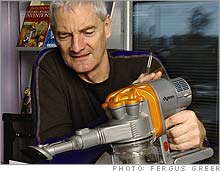
Dyson (above) dislikes e-mail and large meetings, opting for one-on-one interaction. |
I thought of light bulbs, which, although they ultimately go pop, give you 100 watts until then. I saw a possible solution to it, but it was another four years or so before I had it working - another 5,127 prototypes later.
We're known for vacuums, digital motors and hand dryers, but there are plenty of other inventions we're working on, and plenty that have got away. I look for things that don't work properly, things that could be done better, things that are cumbersome or disappointing in performance. Something fails, something is very difficult to use - that's the starting point.
View complacent competitors as an opportunity
I believe if you bring out something better, the people will want it. And so I'm not afraid of being naive. In making vacuum cleaners, I was going into an area which is very densely populated with very big companies that have been making these things for years.
I thought if I was frustrated by a vacuum cleaner, then other people would be too. I wasn't particularly frightened by all these big companies, because I felt they weren't doing anything about it. They were making the same old thing year after year and not really changing the technology.
Find inspiration in your office
My office is a bit like my kitchen. It's got a round marble table, and I sit at an Eames chair. I want a relaxed atmosphere of creativity. I have a few inspirational toys, like model airplanes.
There's also an early underwater Walkman. Akio Morita, who developed it, made his money making tape recorders, and then suddenly he decided to make a thing that played but didn't record. I thought it was a masterstroke.
Communicate directly
I try to avoid the phone and e-mail. If I read three e-mails a day, that's a lot. I would much rather go and speak to somebody. I have a BlackBerry that I don't think is brilliantly designed visually, but the software is very good. A pencil is the tool of my trade. I've got a very nice drafting pencil that I've used since I was at university.
Get high on failure
An engineer's life is 99 percent failure. So failure clearly doesn't depress me. I think it has the reverse effect on me. You don't learn from success, and your successes are few and far between. Failure is like a drug, actually. You go to work each day excited, because you know there are hundreds of problems there that you haven't solved. It's living on the edge, because you might come up with the solution or you might not. The future of the company depends on it.
________________________
A double shot of productivity 



