
Branson's Virgin America gets groundedUsing a 1926 law, old-school U.S. airlines have halted the Virgin founder's bid to launch a domestic carrier. Here's how the British billionaire plans to win the dogfight. Fortune's Peter Elkind reports. (Fortune Magazine) -- With a business empire ranging from cola to cell phones to condoms, Richard Branson was once dismissed by the jolly old British business establishment as a brash, attention-grabbing American-style entrepreneur. Crikey, he even had a CEO reality show, just like Donald Trump. But in his latest venture, Branson's problem is that he simply isn't American enough. His dream of launching Virgin America, a low-fare U.S. airline, has run into a xenophobic buzz saw - a 1926 federal law that bars foreigners from controlling domestic carriers - and a furious onslaught from the airline's would-be competitors. 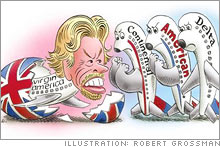 Based in San Francisco, Virgin America has $177 million in financing, seasoned management, plans to fly coast to coast, and nine Airbus jets, to be equipped with comfy leather seats and personal video screens featuring live satellite TV, movies and games. What it doesn't have is permission from the U.S. Department of Transportation to take off. In fact, on Dec. 27, the DOT "tentatively" rejected its application, finding that Virgin America, in which Branson holds only a minority stake, remains under the Brit's "actual control." The Air Commerce Act of 1926 requires that all domestic airlines remain under the control of U.S. citizens. And 1938's Civil Aeronautics Act stipulates further that no more than 25 percent of the voting shares be in foreign hands. The laws were conceived in the early days of commercial aviation, when the thought of foreign planes over U.S. skies was more troubling than ownership of Chrysler by a German automaker like Daimler is today. Virgin argued that it met the standards, but the DOT ruling against it cited offshore partnerships helping finance Virgin, a restrictive contract for use of the Virgin brand, and Branson's role in launching the airline with the help of his own Virgin Group, which operates the international carrier Virgin Atlantic. Virgin America responded on Jan. 17 with a restructured 233-page proposal aimed at making itself acceptably American: The company reduced foreign investment, loosened restrictions in its branding agreement and removed Branson's veto authority over key business decisions. CEO Fred Reid, a former Delta Airlines president, even agreed to step down if the DOT concludes that his hiring by Branson represents a fatal taint. While this addresses the DOT's specific objections, it will probably take months for the agency to rule on whether it believes Branson continues to "control" the carrier. That, of course, has all along been the claim of Virgin's opponents: a combination of the big "legacy" airlines, led by Continental (Charts), American and Delta (Charts), and a pair of pilots' unions. |
Sponsors
|


