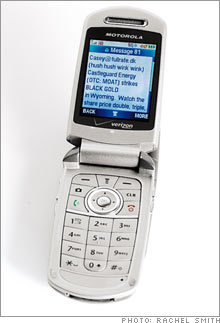
Get outta my phone!Spammers are getting crafty - they're sending text messages to your cell phone. But Fortune's Julie Schlosser is fighting back. (Fortune Magazine) -- It arrived on a Tuesday morning. I flipped open my buzzing Motorola cell phone and found a text message from someone called Casey@fullrate.dk. "Hush hush wink wink," it began, "Castleguard Energy (OTC: MOAT) strikes BLACK GOLD in Wyoming. Watch the share price double, triple, more? Exxon, watch out!" Momentarily, I felt dizzy. Then angry. Then greedy (triple? more?). Then back to angry: I had been spammed where I was least expecting it.
My first response was to retaliate. I tried sending an (unprintable) response to Casey, but it wouldn't go through. From the "dk" in his address, I assumed he was in Denmark - probably eating smoked fish and laughing at me that very moment. Next I decided to phone Castleguard Energy to see if anyone there knew something about the message (or a new gusher in Wyoming). I looked up the company and found that it was based in Dallas, and that its shares were trading for just 7 cents. According to company filings, a gentleman named Harvey Jury is CEO, CFO, president, secretary and treasurer of Castleguard. I figured he was the guy to call. While I waited for him to get back to me, I did a bit of research on cell phone spam. Turns out I shouldn't have been so shocked. The problem has plagued mobile-phone users in text-mad countries like South Korea and South Africa for years. The U.S. has been slower to embrace texting generally - less than half of mobile users do it, according to Forrester Research. But a survey done by the Pew Research Center last year found that 18 percent of U.S. mobile phone owners have received unsolicited text messages. Text spam is now here with a vengeance. It's also illegal. In 2003, Congress enacted the CAN-SPAM act, which prohibits sending unwanted commercial e-mail messages to wireless devices without permission. The rules, which took effect in 2005, allow consumers to receive ads with prior consent or if a business relationship with the sender already exists. Mobile carriers are working hard to prevent spam from driving away customers. In October my carrier, Verizon Wireless, sued some notorious spammers caught sending texts to its subscribers. But more companies are looking to your cell phone as a marketing Holy Grail - which doesn't bode well for consumers. Indeed, a few of my colleagues received their first spam text messages the same day I did. Text spam "will certainly be a growing problem," says David Ferris of Ferris Research, which predicts U.S. consumers will receive 1.1 billion spam texts in 2007, up from 800 million last year. The good news, he says, is that "it will be much less of a problem than e-mail-based spam because in most places it costs to send [text] spam." That goes both ways. Verizon (Charts) told me Casey's message would probably cost me 10 cents. But the customer service rep did offer to put a spam block on my account. Meanwhile, I'm still waiting for my callback from Castleguard's CEO. Maybe I'll send him a text message. ________________ From the February 19, 2007 issue
|
Sponsors
|