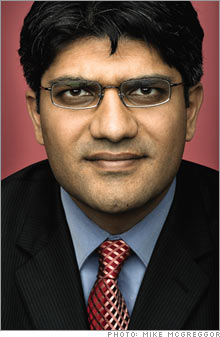
Solar wunderkind sees a bright futureFortune's Anne Fisher interviews Jigar Shah, CEO of SunEdison. (Fortune Magazine) -- In the past couple of years privately held SunEdison, the biggest supplier of solar energy in the U.S., has built mini-power plants in about 200 locations, supplying juice for clients like Staples (Charts), Costco (Charts), Whole Foods Market (Charts) and California State University at Chico. CEO Jigar Shah, 32, launched the company in 2004 with his winnings from a Harvard B-school business-plan contest, and two years later got $26 million in venture money from a group led by Goldman Sachs. Fortune's Anne Fisher talked with Shah about how the stars are aligning for solar power. What exactly does SunEdison do?
We supply solar energy to our customers, supplementary to the power they get from the main grid. Solar now accounts for only about 1 percent of the total electricity produced in the U.S., but we're on a growth curve. Why the sudden growth? Solar technology has been around for a while now, hasn't it? Yes, but the industry is really just starting to take off, led by Germany and Japan. The U.S. is one of the sunniest countries in the developed world - even a far northern state like Maine has more sunny days per year than Germany has - so we should be able to achieve great economies of scale. One thing that is helping is the 30 percent federal tax credit Congress approved in 2005, where companies get a tax break for installing solar-power equipment. What are some of the obstacles to the adoption of solar energy? The biggest hurdle is that the utility industry has created a situation where we have to apply for permission, state by state, from individual utilities to connect a solar plant to their grid. Then you have to deal with a patchwork of different codes at the city level. A few states, like Connecticut and New Jersey, have taken steps to streamline the process. The Department of Energy's new solar-power initiative is designed to educate local utilities and regulators. How cost-effective is solar power? For our customers such as Costco, we can meet 100 percent of their peak energy needs - which is to say during the daytime, when electricity from other sources can cost up to $1 per kilowatt-hour, especially on a hot summer day. Solar power is cheaper during those expensive peak hours. We don't produce power at night. Can the U.S. get self-sufficient in energy? I don't know. I do know that the Department of Energy has predicted that the U.S. will need to add capacity, about 20 megawatts a year [or about 2 percent of our current annual output] over the next decade, to meet rising demand. Right now renewable energy - wind, solar, geothermal - can supply that whole amount. So whether or not we become independent of imported fuels, at least we don't need to become more dependent than we already are. __________________ |
Sponsors
|