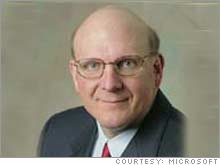
The wrath of BallzillaWhy Microsoft CEO Steve Ballmer can't stop bashing Google. (Fortune Magazine) -- Last month Steve Ballmer, Microsoft's notoriously bombastic CEO, set bloggers blabbing again when he went on an anti-Google tirade that was shrill even for him. In a speech at Stanford's business school, he derided many of Google's forays beyond search and advertising as "cute" stunts produced by a "random collection of people doing their own thing." He also blurted out to the audience that Google (Charts, Fortune 500) was "insane" for trying to grow its headcount so fast. Google's employee base - nearly 11,000 at the end of 2006 - has grown by 250% over the past two years and has nearly quadrupled since Google went public in the spring of 2004. The company can't lease new buildings, much less parking lots, fast enough to accommodate everyone.
The consensus among Internet chatterers seemed to be that Ballmer sounded like a grouchy geezer carping about those impertinent whippersnappers - or come to think of it, like the top brass at IBM (Charts, Fortune 500) and Digital Equipment back in the late 1970s, when they ridiculed the PC as a curiosity for hobbyists. How could Google be insane, especially when you consider that its revenue per employee at the end of last year was almost $1 million, compared with roughly $620,000 for Microsoft (Charts, Fortune 500)? But before we jump on the blogpile, consider where Ballmer is coming from. He runs a company that always has been focused and disciplined and exceedingly pragmatic, ever since it was just a few hundred furry freak brothers taking on Big Blue's tens of thousands of starched white stiffs. Bill Gates has always been stingy, and especially so during Microsoft's formative years. I remember how it caught everyone by surprise when Gates first became a billionaire back in 1987, 12 years after starting Microsoft in a strip mall in Albuquerque. He was 31, still had acne flare-ups, and looked as if he had just slept under a desk - which was, in fact, quite often the case. Even after his net worth reached the tens of billions, he was still flying coach. And Gates was never stingier than when it came to hiring. Right up until he relinquished the title of CEO in 2000, he gave Ballmer a hard time whenever his pal asked for the founder's blessing to "grow headcount." Invariably Gates would dicker him down until Ballmer settled for far fewer hires than he wanted. It didn't matter if Ballmer coyly inflated his requests hoping to split the difference; Gates would always find a way to work him down to the minimum he could live with. So Google's proclamation that it would like to double its employee base, effectively adding 10,000 employees in the coming year, seems more than extravagant to Ballmer. It sounds flat-out crazy. Indeed, to the old guard at Microsoft, Google's approach to just about everything seems alien. It's kind of ironic, because Gates and Ballmer always vowed that they wouldn't let their company become ossified and inflexible in its thinking the way those IBM stiffs had during the microcomputer revolution. Microsoft gave those folks fits, just as Google's equally cocky band of upstarts baffles Microsoft. Paradigm-busting companies like Microsoft and Google don't come along very often in high tech - maybe once a generation. What's different this time is the speed with which Google came to the fore. The Google guys, Sergey Brin and Larry Page, pulled off the same tricks in less than six years and before they turned 30. Their company logged its first billion in revenue far faster than Microsoft did. It hired its 1,000th employee far sooner than Microsoft did. It made its founders billionaires far more quickly than Microsoft did. And those founders bought a commercial jetliner to be their personal aircraft far sooner. Microsoft co-founder Paul Allen didn't get his Boeing 757 until he was in his late 40s, and Gates makes do with some plain old business jet. So maybe it really is just the nature of high-tech companies - as it is the nature of every generation of human being - to think that it is the one that will be different, that it is the one that will break out of the pattern of being outsmarted by the next generation. If that's so, and if the clock is turning faster than ever before, maybe Brin and Page will be carping about the next generation of young whippersnappers even sooner than we expect. From the April 30, 2007 issue
|
Sponsors
|