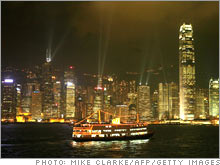
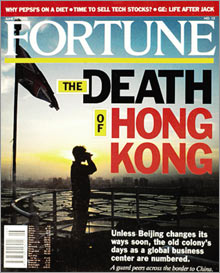
Oops! Hong Kong is hardly deadBack in 1995, Fortune predicted the downfall of Hong Kong once it was handed over to China. But in 2007, the city is thriving more than ever, says Fortune's Sheridan Prasso. (Fortune Magazine) -- Well, we were wrong. In advance of the handover of Hong Kong to China, Fortune wrote a cover story for its international editions, "The Death of Hong Kong" (June 29, 1995), predicting that under Chinese rule Hong Kong would lose its role as an international commercial and financial hub.
It said that English would give way to Chinese, that the level playing field for business would go away and that corruption would take root and spread. "In fact," as we wrote, "the naked truth about Hong Kong's future can be summed up in two words: It's over." Yet ten years after the handover on July 1, 1997, Hong Kong is far from over and hardly dead. What's clear is that economic concerns have won, and that - at least economically - China has left Hong Kong alone to thrive under its "one country, two systems" pledge. And thrive it has. With the exception of a few difficult years during the Asian financial crisis and the SARS epidemic in 2003, Hong Kong has fared well: Economic growth was 6.8 percent last year; capital raised in IPOs - second in the world after London - was $43 billion, up fourfold from 1997; and foreign reserves are 44 percent higher at $133 billion. Hotel occupancy rates average almost 90 percent, up from about 75 percent in 1997 - in part because of an influx of mainland tourists, but also because global business is still looking to cash in on Hong Kong's role as a gateway to China and a financial center for the region. Politically it's another story. Hong Kong's chief executive is chosen by a coterie of business leaders heavily influenced by Beijing. Despite a nascent democracy movement, there's little traction for direct suffrage. But Beijing's role in handpicking the government hasn't translated, as many had feared, into interference in the judicial system or the press, which remain largely independent. Longer term, China's leaders seem to want Shanghai to take a more dominant position as the country's financial capital. But for now, to paraphrase American writer Mark Twain, reports of Hong Kong's death have been greatly exaggerated. From the July 9, 2007 issue
|
Sponsors
|