
The Power 50Ten editions of the Most Powerful Women list prove it: Women have come a long way (don't say "baby") - and they're not slowing down. (Fortune Magazine) -- "Men don't want women getting to the top. Period," Leona Helmsley told Playboy 17 years ago. Whether the late hotel queen was wrong or not, the history of Fortune's Most Powerful Women list shows that women are getting there anyway. When the list debuted in 1998, it featured only three CEOs of publicly held companies - Jill Barad of Mattel (Charts, Fortune 500), Marjorie Scardino of Pearson (Charts), and Linda Wachner of Warnaco (Charts). Now there are 13 CEOs, with 16 more on the international list.
Interactive graphic
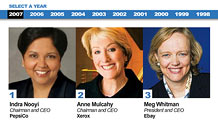 In honor of the 10th edition of Fortune's Most Powerful Women list, we're looking back at who made the top 3 each year.
See them all In 1998 it took oversight of about $1 billion to make the cut; today it's closer to $6 billion. More evidence that the bar is rising: Shelly Lazarus. She was and is the most powerful woman in advertising, yet her ranking has dropped from No. 4 in 1998 to No. 34 this year. What changed? The competition got tougher as more female talent threaded its way up the hierarchy. What hasn't changed is the rigor that informs the rankings. Fortune ranks women at for-profit companies based on the size, importance, and health of their business in the global economy; career momentum; and social and cultural influence. This issue is a testament to the depth and breadth of powerful women. The cover story by Betsy Morris takes us behind the scenes at Xerox, where, for likely the first time in Fortune 500 history, one woman CEO will be succeeded by another. Peter Gumbel takes a high-style look at CEO Angela Ahrendts of Burberry (Charts), and if you haven't heard of Diane Greene, check out Adam Lashinsky's profile of the CEO behind the hottest IPO in Silicon Valley. Sure, there is a paucity of women on corporate boards, as "Women on Boards (Not!)" documents, but there is also a critical mass of likely future CEOs, six of whom are featured in a photo essay. On the whole, we are optimistic; the trend is of genuine and sustained progress that is good for women - and the companies they serve. "I haven't perceived a true glass ceiling for several years," says Carrie Cox (No. 32) of Schering-Plough (Charts, Fortune 500). "There are a whole lot of women ready to reach the top now." |
Sponsors
|




