



Seek Big Rewards in Small Ideas
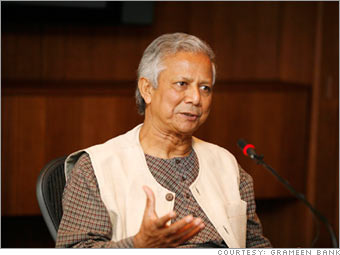
Business today, as it is understood and defined in books, is something you do to maximize your profit. But that is only part of the story, and it's a part that makes human beings look like moneymaking machines, which is not a very noble description of a human being. A human being is much bigger that that. A human being can do many other things, but economics doesn't leave any room for expressing them. There are other kinds of business we can create that are about doing good for people.Business is about problem-solving, but it does not always have to be about maximizing profit. When I went into business, my interest was to figure out how to solve problems I see in front of me. That's why I looked at the poverty issue. I got involved in lots of things to address it, and one of them was money lending with loans and credits and savings accounts, and in the process I created Grameen Bank. So you can also have social objectives. Ask yourself these questions: Who are you? What kind of world do you want?
Most of the problems we have and talk about today sound very complicated, but they aren't. They're simple. And complications actually hide solutions. So when I'm faced with a problem that looks complicated, I try to bring it back to its simplest state. Like poverty. Poverty is not complicated. It's deprivation, a denial of resources. Credit is not available to you, so you cannot move forward. Simple. All it takes is one little step: My first loan was one for $27 that I gave to 42 people. But at Grameen it's not that we lend money to people in small or big amounts; it's that we loan in an appropriate amount to their needs. The size is small because the need is small. I could complicate things: I could lend a person $1 million, but if that someone can only handle $20, that would be stupid. But if she can handle $20, it makes sense, and that's still big money for her. So I say, when you're trying to solve a problem, always bring it back to the simplest formulation.


