|
The "Pillsbury Doughboy" jumps the fence
DEC. 28, 2005
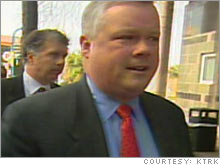
 NEW YORK (FORTUNE) - For nearly two years after FBI agents first led Richard Causey, Enron's former chief accounting officer, into the federal courthouse in handcuffs, he asserted his innocence, claiming that there was nothing wrong with Enron's accounting. In doing so, he provided a valuable buffer for Lay and Skilling, who will insist they relied on his expertise -- as well as that of outside lawyers and accountants -- in concluding that everything Enron was doing was proper. But three days after Christmas everything changed when Causey agreed to plead guilty to a single count of securities fraud, cooperate with government prosecutors, and serve up to seven years in prison. Was it a simple case of a CPA engaged in calculation, as attorneys for Lay and Skilling insisted? Causey, they asserted, committed no crime but knuckled under to government pressure, wishing to avoid the financial burden of defending himself at trial and the possibility of a much longer jail term away from his family. Or had he undergone a change of heart, recognizing that what he had done amounted to fraud?
Either way, Causey's plea changes everything. For starters, it is addition by subtraction for the prosecution: By cutting out Enron's chief numbers man, it makes the trial both shorter and simpler, minimizing the quantity of mind-numbing accounting testimony. Second, it adds Causey -- known at Enron as the "Pillsbury Doughboy" -- as a credible, likable witness against Lay and Skilling, with whom he had extensive personal contact. What Causey has admitted, in a brief plea agreement, embraces the broad sweep of the government's overarching claim against Lay and Skilling -- that he conspired with the company's "senior management" to inflate the company's stock by lying to investors about Enron's true financial condition. More specifically, Causey acknowledges signing financial statements that he knew misled investors about two transactions. One falsely characterized a one-time $85 million gain as the result of Enron's recurring operations. In the second case Causey admits helping hide hundreds of millions in losses in Enron's retail energy business by shifting them into the company's highly profitable energy-trading unit. Both admissions involve criminal charges the government has filed against Skilling. And this, certainly, is not all. Causey's signed plea agreement characterizes the document as merely "a summary of facts that make me guilty," adding, "It does not include all of the facts known to me concerning criminal activity in which I and other members of Enron senior management engaged." In fact, Causey may well have something to add on most of the charges facing Lay and Skilling. No one was more in the thick of things, more intimate with Enron's desperation, quarter after quarter, to make its Wall Street numbers. And no one was more versed in the tactics it employed--legal and otherwise--to do so. Even before the company's collapse it was always difficult at Enron to separate reality from illusion. What happens in the months to come in a Houston courtroom will provide, if not clarity, at least an ending. _________________________ The former Enron chiefs fear a Houston trial may be their downfall -- full story here.
For all the latest headlines in Companies, click here. |
| ||||||||||||||||||||||||||||||||||||||