|
Is that a PC in your pocket?
Thanks to slick new software, cell phones are getting as powerful as PCs.
 SAN FRANCISCO (Business 2.0) - Last week at Davos, Bill Gates suggested giving the world's poor cellphones--not PCs--to connect them to the Internet. But why limit the plan to the poor? It may not be widely known, but today's cellphones pack as much processing power as personal computers did just a few years ago. What's been missing is the range of software that PC users enjoy.
But software developers are at long last beginning to home in on the opportunity. With nearly 1.8 billion phones in use worldwide, and an 800 million new phones sold last year alone according to research firm IDC, mobile phones already represent a far larger software opportunity, in theory, than PCs. Phones with plenty of juice
And with cheap processors, full-color screens, high-speed cellular networks and versatile software standards like Sun's (Research) Java programming language, the mobile phone is becoming increasingly indistinguishable from a PC. For proof, just look at Palm's (Research) Treo or Nokia's (Research) latest smartphones. Yet, as Gates discovered long ago, it is compelling software that drives adoption of new hardware. The personal computer didn't become truly popular until the advent of easy-to-use web browsers, good search technology and email. The mobile phone is at a similar inflection point. Today, the vast majority of people still use phones for little more than their original purpose—making phone calls. But thanks to the work of developers creating useful software for cellphones, that's about to change. Mobile browsing
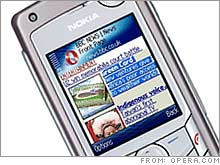
Norway's Opera Software, which also has a browser for PCs, recently unveiled what's quickly become recognized as the best cellphone Web browser yet, known as Opera Mini. (Visit mini.opera.com to download a free version, available for most popular phones.) Early phone browsers were notoriously crude, requiring online publishers to create dumbed-down versions of their websites. Opera's insight was to create a system that would reformat webpages for display on small screens. And it works beautifully. On an older Audiovox phone, the top story on www.nytimes.com loaded in a matter of seconds, including a full-color picture. Even with Opera's browser, though, it makes sense to rework some Web-based applications for mobile phones, because when users are on the go, their needs change. Google's new Local Mobile search (www.google.com/glm) is a good example. The application combines the visual appeal of Google's satellite maps with powerful search algorithms, but it's most notable for what it leaves out. "We worked hard to optimize our search tool for mobile phones," says Google (Research) product manager Gummi Hafsteinsson. "Right now, people tend to use it for driving directions and to look up a lot of general listings in their area." Emailing on the fly
If you're looking for a mobile email application, there's certainly no shortage of options. Research in Motion's (Research) BlackBerry handhelds come with email built in, while Good Technology, Visto and Seven Networks are just a few of the companies providing email software for a variety of cellphones. Yet amidst this crowded field, the best may well be the product of Movamail, a tiny Vancouver-based startup. Movamail's email client (called, like the company, Movamail) allows users to view just about any email account, including Gmail, Hotmail, and Yahoo Mail. Since it launched in the fall of last year, the application has been downloaded 400,000 times, thanks, in large part, to positive word of mouth. Movamail's popularity springs from its speed and ease of use: Like Opera's browser, Movamail's product strips email down to the bare essentials and sends it to phones in small batches of data, to ensure they load quickly. After a 60-day trial, the service costs $29.99 a year. Carriers including Orange in Australia are already considering offering Movamail's client to their users. These three applications should be enough to turn any cellphone into a basic computing platform. But they're just the tip of the iceberg. According to data from research company M:Metrics, the number of mobile applications is growing 50 percent a year. That's a far more vibrant market than the moribund PC-software business.
No wonder that Gates has cell phones on his mind. |
|