|
Home sales: Is the market glutted?
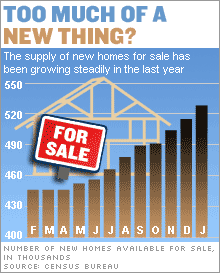
January report shows 5% drop in new home sales from December, building boom has resulted in 20% more new homes on the market than a year earlier; new homes are taking longer to sell.
NEW YORK (CNNMoney.com) - The pace of new home sales slowed in January, according to a government report Monday that included the latest sign of a growing glut of new homes on the market in some areas. The Census Bureau reported that new homes sold at an annual rate of 1.23 million homes in the month, compared with the revised 1.3 million home pace in December. Economists surveyed by Briefing.com had forecast that January new home sales would remain little changed at the 1.27 million pace originally reported in December.
The report showed there was a 5.2 month supply of new homes on the market in January at the current pace of sales, as the number of new homes available to be sold rose to 528,000. That's up 2.5 percent from December and up 20 percent from the number of homes available in January 2005. The report marked the first time the supply of new homes crossed the five-month mark since November 1996, according to historical data from the bureau. The market had an average of a 4.5 month supply of home on the market throughout 2005. David Seiders, chief economist for the National Association of Home Builders, said it is too soon to say there is a glut of new homes on the market. But he said the latest report does confirm other readings that show a softer market for new home sales than seen during the record pace set last year, when a total of 1.29 million new homes were sold. "There's been a definite upswing in the inventory level for some time," said Seiders. "The months supply was held steady by a pretty strong sales pace. The big reason for the big uptick in months supply is the slowing sales pace." Seiders said there's no real correlation or effect on new home sales and the weather, but the warmest January weather in history could also have fed into the increase in months supply because the Census Bureau considers homes that are permitted or recently started as part of the available inventory. The warm weather prompted much stronger-than-expected starts and permits. But even the report's figure on median time it took for completed homes to be sold rose to 4.5 months from a median of 4 months throughout 2005, a number that wasn't affected by the warm January weather. Home builders have reported an increased number of orders for new homes being cancelled in recent months, raising concerns that buyers who were looking to real estate for an investment rather than their own housing needs are pulling out of the market. Such cancellations could put downward pressure on prices in some formerly hot markets. Home builder Toll Brothers (Research) warned last week that it is seeing greater supply than demand of new homes in a number of markets, and it pointed to the drop in interest by investor-buyers. "Speculative demand has ceased and speculators are now putting their homes back on the market. The result has been more supply than demand in some regions," said the company's earnings statement. "Markets such as metro Washington, D.C., which are sound economically and showing healthy job growth, will need to work through their excess supply before the imbalance once again tips in our favor." Still, the pricing information included in the report showed little weakness. The median home price, the price at which half the homes sold for more and half sold for less, was $238,100, unchanged from the median price for all of 2005 and up 4 percent from the December reading. The January median is also up nearly 7 percent from the year-earlier level, although it has slipped a bit more than 2 percent from the record $243,900 reached in October. But the strong prices could only continue to feed the oversupply of houses that seems to be developing, and could lead to a larger correction in the market in the future, said Dean Baker, co-director of the Center for Economic and Policy Research and a long-time advocate of the theory that the current housing market represents a so-called "bubble" that could see a broad decline in prices in the future. "Builders will keep building as long as they can keep getting these prices," said Baker. "But I think there's a glut developing clearly in some markets and that clearly will put downward pressure on prices."
For a look at how the strong housing starts number in January may have been so much hot air, click here. |
|