|
Origami looks paper-thin
As Microsoft's new handheld unfolds, analysts say it's too pricey and unfocused.
 SAN FRANCISCO (Business 2.0 Magazine) - With details swathed in secrecy and buzz created by a mysterious website, Microsoft's Origami handheld debuted Thursday at the CeBit trade show in Hannover, Germany, to great expectations. A handheld that needs a grip
But analysts were quick to point out that Origami's lack of focus made it an implausible competitor to Apple's iPod or Sony's (Research) PlayStation Portable.
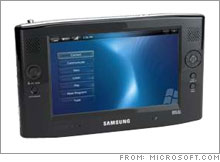
Instead of launching its own device, Microsoft (Research) created the specs for Origami, a new ultra-mobile PC, or UMPC, and lined up hardware makers to manufacture the devices. UMPCs will run a modified version of Microsoft's Windows XP operating system, with a form factor that bridges the gap between a personal digital assistant and a notebook computer. The devices are expected to sell at prices between $599 and $999. UMPCs can play videos, music and games, among other content, but can also run standard Windows programs. The new class of devices has a special user interface for easy access to digital content, games and other such applications. Microsoft says that these devices typically will weigh less than 2 pounds and feature a 7-inch screen, and have built in Wi-Fi and Bluetooth Tellingly, Microsoft has yet to sign up any major U.S. PC makers for Origami. Samsung, the South Korean consumer electronics maker, and Asustek, a Taiwanese computer maker, are the only manufacturers showing off devices at CeBit. Hobbyists only
Michael Gartenberg, an analyst at Jupiter Research who tracks the digital device industry, says that Origami UMPCs will excite early adopters. Gartenberg sees the geek set carrying them around as "reference devices" used to quickly check e-mail or look up documents. But the UMPC faces several hurdles on the road to mass adoption. The biggest shortcoming is its three-hour battery life, which is a quarter of Apple's (Research) iPod, which can also play video, and much less than that of a high-end smartphone, which can check e-mail and display office documents. "This is yet another failed attempt to jam everything into one device," says Pip Coburn, technology strategist with Coburn Ventures, a New York-based investment advisory firm. "The way I see it, they don't really know what they want it to be." Coburn believes Microsoft needs to simplify Origami devices and bring more focus to their form and function, just as they did with the XBox 360 game console. "It would be great if they did a PlayStation Portable competitor," says Coburn. Ashok Kumar, an analyst with brokerage firm Raymond James, says that the new devices need to have cellular connectivity, not just Wi-Fi and Bluetooth. Carriers like Verizon Wireless, Sprint Nextel (Research), and Cingular already subsidize expensive smartphones in the hopes of getting customers to sign up for pricey data plans. Adding support for high-speed wireless connections could win similar subsidies for UMPCs, bringing the price down to a more attractive level for consumers. "At $999, consumers are not going to bite," says Kumar. Cynthia Brumfield, president of Emerging Media Dynamics, a consulting group, agrees that the UMPC is too expensive for consumers. "If the price stays at the $600 to $1,000 range, Microsoft will have a tough time distinguishing [Origami] from low-end laptops or notebooks," says Brumfield. "However, if the manufacturers can get the price down, and Microsoft positions it as a truly portable multimedia device that also comes equipped with all these office productivity applications, then [Origami] is, I think, a winner. I don't think this is a video iPod killer -- Microsoft is just not....cool. But the enterprise market is ready for a portable media device with a big screen that can serve as a computer." In other words, don't expect an iPod-like gold rush for Microsoft. At least not yet.
To send a letter to the editor, click here. |
|