|
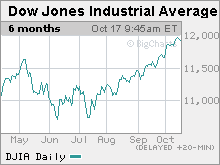
Stocks can't break record Inflation concerns dash hopes for a Dow push past 12,000; Techs rise after hours. NEW YORK (CNNMoney.com) -- Stocks finished lower Tuesday, ending a three-session winning streak, with renewed inflation concerns taking the Dow away from the 12,000 mark. But the Dow could take another run at 12,000 Wednesday, with several big tech names rising after the bell on solid earnings reports.
Despite a late-day push, the Dow (down 30.58 to 11,950.02, Charts) fell 0.3 percent Tuesday. The broader S&P 500 (down 5.00 to 1,364.05, Charts) index declined 0.4 percent while the tech-fueled Nasdaq composite (down 18.89 to 2,344.95, Charts) lost around 0.8 percent. All three gauges moved off lows hit earlier in the session. The dollar fell, Treasurys gained and oil lost more than $1 a barrel to settle below $59. After the bell, Intel rose one percent after the chipmaker reported lower quarterly profits but beat analysts estimates nonetheless. Technology services company IBM (Charts) rose three percent on a higher quarterly earnings the company attributed to better software sales. IBM's earnings beat estimates by 10 cents. Yahoo (Charts) shares seesawed after the Internet company reported earnings in-line with estimates. The only dark spot was Motorola (Charts), which tumbled 8 percent after the mobile phone maker met earnings estimates but fell short on revenue and issued guidance at the low end of estimates. Tuesday's decline tempered hopes that the Dow would cross the 12,000 mark, which it came within three points of hitting Monday, before pulling back a bit to end around 11,980. That number was still another record close, unadjusted for inflation. With all the tech earnings due after the bell, investors were bracing for the worst during normal trade. The AMEX networking index fell over 2 percent and the Goldman Sachs Internet Index lost about 1 percent. Intel was one of day's biggest losers in the Dow, its stock tumbling nearly 3 percent, after the company was downgraded from "buy" to "neutral" by Goldman Sachs. Inflation fears Tuesday morning the Producer Price Index, a measure of prices on the wholesale level, fell far more than expected, mostly due to tumbling gasoline prices. The index posted a drop of 1.3 percent, according to the Labor Department. Economists expected a decline of 0.7 percent. But Wall Street focused more on the so-called core PPI, which strips out often volatile food and energy prices. That reading rose 0.6 percent in September. Economists had forecast only a 0.2 percent rise in the core PPI. "Although the earnings are reasonable, I think the market is looking at Fed policy," said Subodh Kumar, chief U.S. investment strategist at CIBC World Markets. "Part of the thinking was that the Fed might ease soon. But now we've got some hard numbers that say they can't afford to do that." Another morning economic report also raised concern. The government said output at mines, factories and utilities fell by a sharp 0.6 percent in September. Analysts were looking for output to be flat. The troubling economic news overshadowed positive earnings reports that came earlier in the morning. Conglomerate United Technologies (down $1.51 to $65.28, Charts) reported earnings per share of 99 cents, 3 cents better than estimates. It also raised its full-year earnings guidance. Nonetheless, its shares declined over 2 percent. Brokerage firm Merrill Lynch (up $0.41 to $84.52, Charts) reported earnings of $2 a share, excluding special items, as it trounced First Call's forecast of $1.47. Drug and consumer products maker Johnson & Johnson (up $1.15 to $66.08, Charts) also reported improved results that edged past forecasts by 1 penny a share. JNJ shares rose nearly 2 percent. On the takeover front, Chicago Mercantile Exchange (up $13.25 to $516.50, Charts) agreed to buy the Chicago Board of Trade (up $17.48 to $151.99, Charts) in an $8 billion stock and cash deal. And Eli Lilly (down $0.11 to $57.55, Charts) is buying ICOS (up $4.38 to $31.50, Charts), the maker of the erectile dysfunction drug Cialis for $2.1 billion in cash. The $32 per share purchase price is an 18 percent premium from Monday's close. Geopolitical concerns also weighed on the market. Officials in South Korea and Japan said there were signs that North Korea could be preparing for a second nuclear test. Stocks closed mostly lower in Asia despite the North Korean nuclear concerns, as Japan's Nikkei retreated from a five-month high and stocks in South Korea were lower, although Hong Kong's Hang Seng closed narrowly higher. Major gauges in Europe finished sharply lower. Oil prices fell ahead of Thursday's OPEC meeting, at which the oil cartel is expected to weigh production cuts. U.S. light crude lost $1.01 to settle at $58.93 a barrel on the New York Mercantile Exchange. Treasury prices were higher after the PPI report, dropping the yield on the 10-year note to 4.77 percent from 4.78 late Monday. The dollar was lower against the yen and euro. COMEX gold fell $5 to settle $593.50 an ounce. Market breadth was negative. On the New York Stock Exchange, losers beat winners five to three on volume of 1.5 billion shares. On the Nasdaq, decliners topped advancers three to two volume of 2.2 billion shares. _________________ Second wind for the bull market |
|