NEW YORK (CNNMoney.com) -- Well, so much for starting the year off on a positive note.
Five sessions into what is seasonally a strong time of year, stocks have slipped. Granted, they've only slipped very modestly. But, according to the Stock Trader's Almanac, that may be a bad sign for the rest of the year.
According to what the Almanac calls the "early warning system," how the S&P 500 performs in the first five sessions of the year can be an indicator of how it will perform for the full year.
How'd we do in the first five sessions of 2007? The S&P 500 lost 0.4 percent.
A decline of 0.4 percent is not exactly cause for alarm. But a gain in this period would have been better, historically speaking.
Since 1950, when the S&P 500 posted a gain during the first five sessions of a year, the market ended higher 85 percent of the time. When it posted a loss, the results were less notable - the market closed higher half the time and lower about half the time.
Beyond the first week
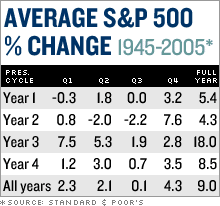
There are many market indicators that suggest 2007 will be a strong year. For one, 2007 is a year before a presidential election. People who think the stock market follows the four-year cycle of the presidency consider that a good thing.
The Dow Jones industrial average hasn't fallen in a pre-election year since 1939, amid World War II, according to the Almanac. That's because in the year before and the year of a presidential election, the party in power does what it can to stay in power and not alienate voters, including keeping the economy strong and money in the hands of consumers.
Plus, there are plenty of reasons to suggest that 2007 will be an upbeat year regardless of the seasonal factors: the economy appears to be slowing, but not heading for recession; the Federal Reserve could start cutting interest rates later this year; commodity prices are moderating; and earnings are still growing faster than the historical trend (although at a slower pace than in recent quarters).
And for market indicator geeks, there is the January test that investors still have time to ace: the so-called "January Barometer." The barometer, according to the Almanac, says that as the S&P 500 goes in January, so goes the year.
This has been accurate 75 percent of the time since 1950. In pre-election years it's been accurate in 13 of the last 14.
10 big ideas for 2007
Oil: Looking for the bottom
More on the markets
More on investing