
Homeowner claims: Increase your payoutsInsurers have several ways of keeping down costs. Here's what you need to know. (Money Magazine) -- An insurance company that wants to hold down payout costs has several ways to do that. One involves the software designed to help assess financial damages. The program most widely used in homeowners coverage, called Xactimate, comes preloaded with typical repair and replacement prices for more than 15,000 items, broken down by zip code. 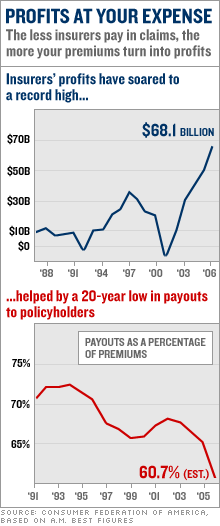 Thus armed, an adjuster can walk through a house, plug in information such as the number of windows that must be installed and the area of carpeting to be replaced and quickly deliver an impressively precise itemized assessment of what it will all cost. The adjuster might not mention, however, that it's possible to override the prices in Xactimate. An insurer might instead insert fees charged by "preferred" vendors who agree to work at discounted rates to get regular referrals from insurers. Farmers spokesman Jerry Davies confirms that Farmers occasionally does this in markets where its vendors can beat the going Xactimate rate, but he adds that its vendors do "top-quality work." Even so, you may prefer to have your home rebuilt by a contractor beholden to you, not your insurer - but if you do, you may have to pay the difference yourself. If you have replacement-cost coverage on your house - and you should - be alert to another potential pitfall. (Replacement cost is a type of policy that promises you'll be paid the full amount needed to repair or replace your damaged property.) Most companies initially reimburse you only for the "actual cash value" of your loss, or replacement cost minus depreciation. To get the additional benefit, you have to provide receipts showing how much you actually paid. If you can't pay up front, you may be out of luck, says Steve Strzelec, a Seattle claims consultant. Meanwhile, many policyholders who do pay out of pocket never get the extra money to cover their replacement costs because they don't know they're entitled to it. How much is left on the table? Hard to tell. But an internal study made public during a lawsuit this year estimated that in 1999 alone State Farm customers failed to claim as much as $135 million in replacement-cost benefits. The insurer told Money Magazine it began paying replacement costs up front in 2000, but saw an "unexpected spike" in claims, so it returned to paying only actual cash value up front in 2003. How to protect yourself when making a claim It should be clear by now that the prudent course is not to assume that your insurance company will automatically offer you all you're entitled to. Even before the insurance adjuster arrives, contact a few contractors in your area to get estimates of what it will cost to restore your home to its original condition. If the insurer matches those estimates, great. If not, you'll have a better sense of how much more you need to push for. If your carrier won't budge from an offer you feel is too low, invoke the appraisal clause that's part of most homeowner policies. You and the insurer both hire appraisers, and they try to agree on a binding settlement. If they can't, an umpire selected by the appraisers or a judge will arrive at a figure. If you feel the adjuster you've been dealing with is stalling or delaying your claim, explain your view of the situation in a letter to the claims manager who oversees the adjuster and request that the manager intercede to expedite the claim. If that doesn't bring satisfaction, move up to the regional claims manager and, if necessary, the executive in charge of the claims department. And if you have replacement-value coverage and receive only the actual cash-value portion of your claim initially, keep meticulous receipts of what you shell out for materials and labor. You'll need them to claim the share that was held back once the job is done. Also be aware that many insurers may be willing to advance the full replacement cost up front once you sign a contract with a builder to do repairs - if you ask. So ask. ____________________ More from the Money Magazine special report: Neutron bomb of health insurance: Suddenly not covered What you can do: Improve your odds of getting the policy benefits you expected |
|


