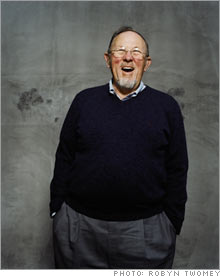
The man who explained it allBill Sharpe's pioneering theory on the interplay between investment risk and return won him a Nobel Prize. Now he wants to help you use his work to make better financial decisions. NEW YORK (Money Magazine) -- Once you win a Nobel for explaining the fundamental principles that drive the financial markets, there are two things left for you. You can retreat to the ivory tower, write incomprehensible research papers and join the boards of a bunch of hedge funds. Or you can put your theory to work helping regular people invest smarter.
Stanford professor William F. Sharpe chose option B. After sharing the 1990 Nobel in economics, he co-founded Financial Engines, a company that helped lift retirement planning out of the dark ages. Today, Sharpe keeps at his research - his new book, "Investors and Markets," is an advanced look at investing theory - even as he explores innovative solutions to everyday financial problems. Question: What's the bottom line from your Nobel work? Answer: I wanted to answer why people act in certain ways when they invest and how risk and return are related. The bottom line: Yes, Virginia, some investments do have higher expected returns than others. Which ones? Well, by and large they're the ones that will do the worst in bad times. Question: So the price of reaching for higher returns is greater risk. Answer: If you want more return, you have to take more risk of doing badly in bad times. You can't just say, "Let's go for a really hot stock." That doesn't guarantee a higher return. Q. What does? Answer: The only way to be assured of higher expected return is to own the entire market portfolio. Question: You can easily do that through a simple, cheap index mutual fund. Why doesn't everyone invest that way? Answer: Hope springs eternal. We all tend to think either that we're above average or that we can pick other people [to manage our money] who are above average. That's what makes markets - when one person thinks he knows more than somebody else, information is exchanged and a new stock price is set. And those of us who put our money in index funds say, "Thank you very much." We get to free-ride on other people's convictions. Question: You once called financial planning a "fantasyland." Answer: The typical financial plan used to decide how much people needed for retirement largely by assuming something like, "Stocks will earn 10 percent every single year, and you will die exactly when the mortality tables say you should." Then it ran the numbers, and if at the end you were projected to die before your money ran out, it said, "Hot dog! You win!" Things are a lot better now. Many firms use Monte Carlo software [which randomly samples past returns to project possible future results] that works both risk and return into the equation - especially the risk that your investments might generate less return than you need. Question: What if your adviser talks only about returns, not risk? Answer: Look, think for a second about what each of you knows. You know about you: who you are, what your goals are. Your financial planner knows - or is supposed to know - about the risks and returns of the capital markets. It's his job to take risk into account by telling you the range of possible outcomes you face. If he won't, go get a new planner, someone who will get real. Question: You've said that four verbs can summarize the principles of good financial advice. What are they? Answer: Diversify, economize, personalize, contextualize. Question: Decipher-ize for us, please. Answer: Diversify, diversify, diversify! The closer you come to holding the entire market portfolio, the higher your expected return for the risk you take. Economize by avoiding unnecessary investment expenses, especially management fees and trading costs. Personalize by taking into account the things that make your situation unique, especially the risks you face outside the financial markets. As an extreme example, imagine that all you eat is chocolate bars. In that case, you'd want to invest more in the stock of candy makers so that if they raise prices, your food will cost more but your stock will go up. Finally, contextualize. Remember, if you bet that market prices are wrong [by investing heavily in a single stock or sector], you have to be able to justify why you're right and the market isn't. Asset prices are not determined by someone from Mars. Minds over Money: In honor of Money Magazine's 35th anniversary, we're running special interviews with the smartest thinkers we've come across in three-plus decades. John Rogers: Buy. Hold. Profit. Give Back. Robert Shiller: Mr. Worst-case scenario Jack Bogle: Still scolding after all these years Olivia Mitchell: Scholar of the boomers' future Ralph Wanger: Winning the home run hitter's game Charles Schwab: The smartest way to invest |
| ||||||